If you have researched studying MBBS in China for more than a couple of weeks, you have by now inevitably stumbled upon the concept of the HSK. It is mentioned in passing by most sources, barely explained, and quickly moved on to in order to discuss more interesting topics such as tuition fees and PMDC recognition. But for a lot of Pakistani students, HSK ends up being one of the most stressful parts of the entire six year journey, and almost nobody explains clearly what actually happens if you don’t clear it. So let’s actually talk about it properly.
What HSK Even Is
HSK stands for the Hanyu Shuiping Kaoshi (HSK) – a standardized proficiency test of the Chinese language, similar to the IELTS or TOEFL English tests. It is divided into levels from 1 to 6, where level 1 represents an elementary knowledge of Chinese suitable to communicate in simple sentences, and level 6 is near-native proficiency. The required level of Chinese for MBBS students depends on the chosen university, which can be around level 3, 4, or even 5 for some institutions.
HSK is the source of great confusion among many students due to the difference in requirements depending on the university and faculty; thus, it is important to distinguish the particular demands of the chosen educational institution. It genuinely depends on whether your university is MOE listed or not.
MOE Listed Universities: HSK Isn’t Usually a Wall
China’s Ministry of Education has approved a specific list of around 44 to 45 universities to teach the MBBS program fully in English. If you’re at one of these MOE listed universities, your admission letter and visa letter will clearly say something like “MBBS in English,” and technically HSK is not a mandatory graduation requirement for you. You will still need to take basic Chinese classes during your first or second year or so; they serve a purely practical purpose, to prevent you from being completely lost outside the university compound, but generally, you can get away with not achieving a very high level on the HSK exams.
That being said, this does not mean that Mandarin is an entirely expendable skill in your medical education, once you get to the clinical years and begin doing your internship, you will have to interact with Chinese patients, doctors, and nurses. If your Mandarin is close to zero at that point, your clinical training becomes genuinely difficult, not because of any rule, but because you simply can’t communicate properly with the people you’re supposed to be learning from. Students who ignore Chinese completely in years one and two often regret it badly by year four or five.
Non-MOE Universities: This Is Where HSK Becomes a Real Requirement
If you’re at a non-MOE listed university, meaning a bilingual program rather than a purely English medium one, the rules are stricter. These universities typically dedicate your entire first year to intensive Chinese language study, and you’re expected to clear HSK 3 or HSK 4 by the end of that year before you’re allowed to move into actual medical subjects. Some universities push this further, requiring HSK 4 or even HSK 5 by later stages before graduation.
This is the situation where not passing HSK has real, immediate consequences, so let’s go through what actually happens.
If You Don’t Pass the First Time
Do not worry, it is very common and most likely you will get another opportunity to take the exam. Most universities offer the option to repeat as they know this is a very difficult exam and it is held multiple times a year, so you should wait no more than a couple of months. Most universities should have some kind of remedial classes or extra help from teachers or fellow students who have taken the exam previously.
If You Repeatedly Fail to Clear the Required HSK Level
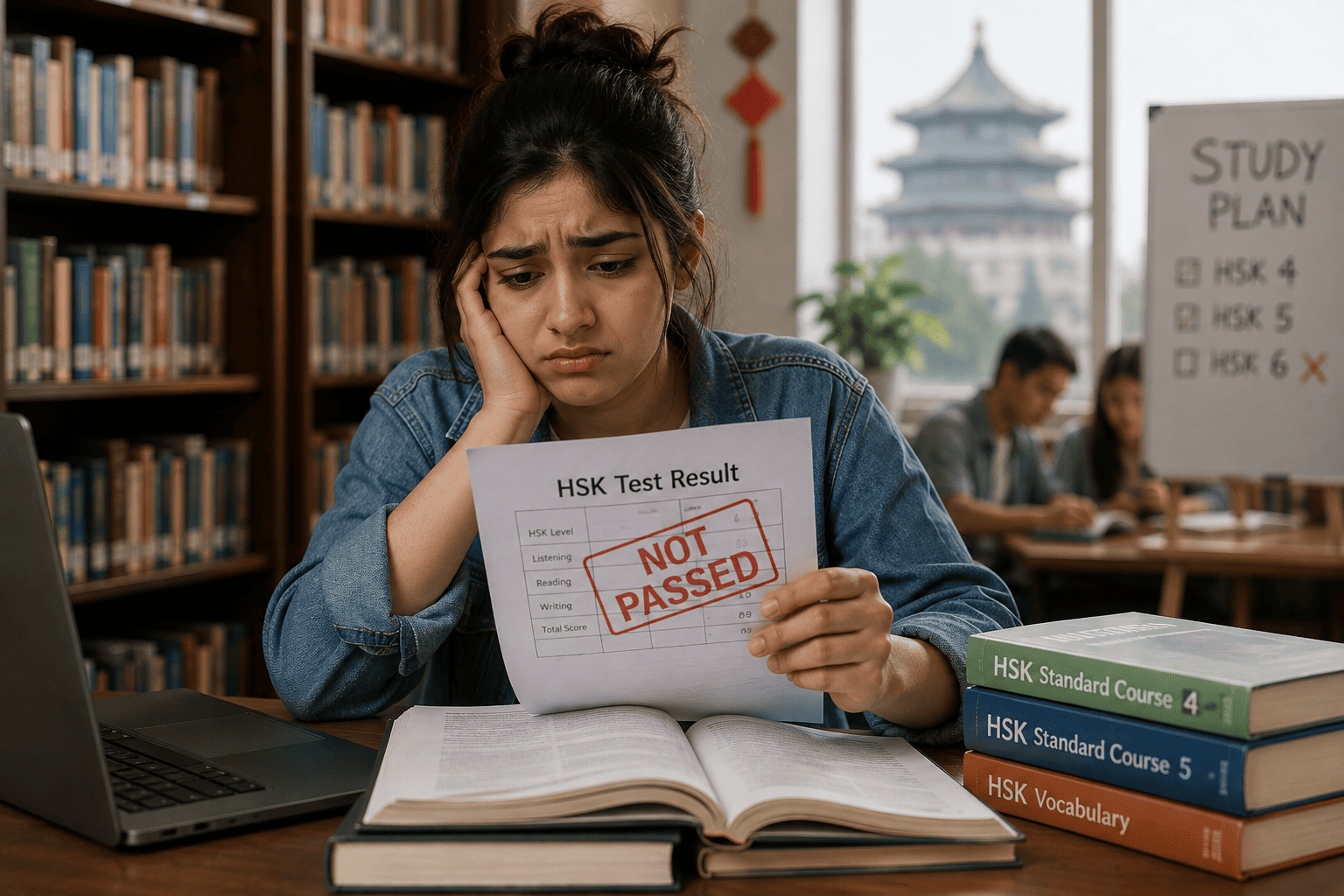
This is where things get more serious. At most non-MOE universities, if you fail to pass the required level of HSK by the end of the first year, then you are prohibited from proceeding to second year medical courses, which would effectively mean the end of your study. In practice this means one of the following scenarios.
You repeat the language year. This is the most common outcome. You essentially stay back and continue Chinese language classes for another semester or full year until you clear the required level. This obviously means your total MBBS timeline stretches out, sometimes by a full year, and you’ll typically have to pay for that extra year of tuition and hostel costs out of pocket, since it wasn’t part of your original financial plan.
Your visa situation needs to be sorted out. Chinese student visas are generally tied to your enrollment status and expected program duration. If you’re repeating a year, the university usually needs to help you extend or adjust your visa documentation accordingly. This is manageable, but it does add paperwork and sometimes delays.
You may lose or risk losing a scholarship. This is one of the more painful outcomes for students on CSC scholarships or other government funded programs. Many of these scholarships come with academic performance conditions attached, including language proficiency milestones. Failing to meet HSK requirements on time can, in some cases, put your scholarship at risk, meaning you might suddenly be responsible for tuition and living costs you weren’t expecting to pay.
In rare, extreme cases, actual dismissal. This is uncommon and usually only happens after multiple repeated failures over an extended period, combined with poor attendance or other academic issues. Universities generally don’t want to dismiss students, since international student enrollment matters to them too, so this is very much a last resort scenario rather than something that happens after one bad exam.
Why This Catches So Many Students Off Guard
Honestly, a big part of the problem is that a lot of consultants either don’t explain this clearly or actively downplay it while trying to close an admission. Chinese language study appears as a formality while filling the admission form in Pakistan, and it becomes a practical aspect only when one lands up in China among classmates who might be learning Mandarin at a faster pace, in an academic system which assumes a certain pace of learning that not everyone can adopt right from the first year.
Students who join the Chinese language course directly from the English medium schools in Pakistan, without any background of Mandarin language, underestimate the difficulty level of the language and its script, and misinterpretation sets in at a very fast pace from the time of examinations.
How to Actually Avoid Getting Stuck Here
Make sure to take the first year Chinese classes seriously and actually attend the ones you are enrolled in and not try to save them for later. Since Chinese is such a big language to learn, it’s better to have a little bit more time to fully understand every lesson than to cram for it all right before the exam.
Also, practice with online tools such as HSKOnline, Pleco or HelloChinese, in your limited free time aside from the classes themselves, especially leading up to your exam. A lot of successful students say the extra thirty minutes a day outside class made the real difference.
Study with local Chinese classmates when possible, not just fellow Pakistani students. Genuine conversation practice, even basic small talk, builds listening and speaking skills far faster than textbook study alone.
Ask your university directly, before you even enroll, exactly what HSK level is required, by when, and what the university’s actual policy is for students who don’t clear it on the first attempt. This is a completely reasonable question to ask during admission, and any consultant or university representative who gets evasive about it is worth being cautious around.
The Bigger Picture
Not only did they pass the test, but they also got good scores. This is true for those students who didn’t pass HSK on their first try.
The most important point is to get familiar with what kind of university you are going to, its own rules regarding HSK, and take it seriously from day one, not on the sidelines. A little discipline early on saves you an extra year of tuition, an extra year away from your family, and a lot of unnecessary stress later in your MBBS journey.