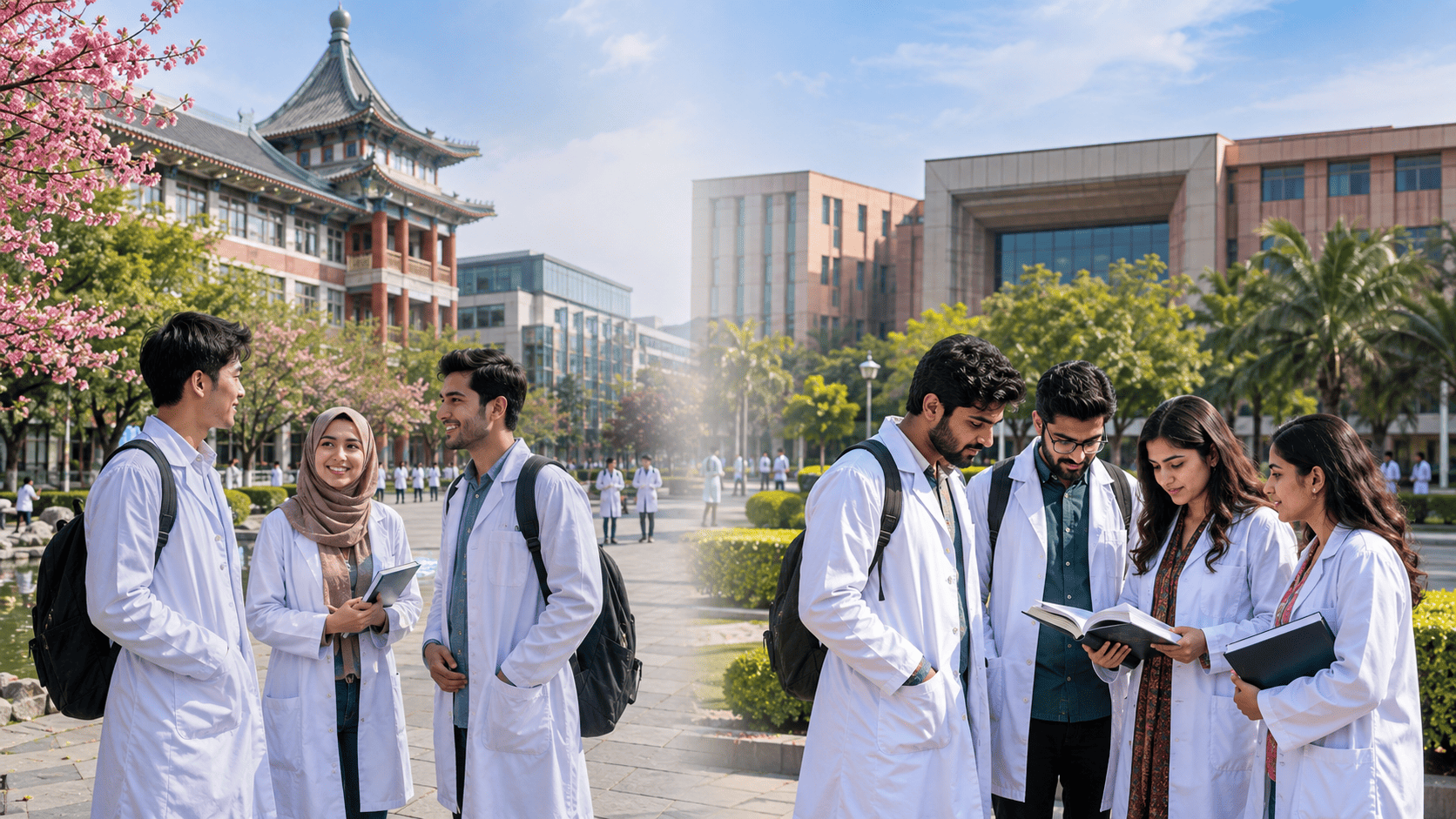
This is probably the single most common question every FSc pre-medical student in Pakistan ends up asking, usually right around the time MDCAT results come out. Some students score high enough to walk into a government medical college without much stress. A huge number don’t, and that’s when the real decision begins: pay an enormous amount for a private college in Pakistan, or look at China instead. There’s no universally correct answer here, but there is a lot of practical, updated information that can help you actually make the decision instead of just going with whatever a consultant tells you.
The Cost Difference Is the Biggest Factor for Most Families
Let’s start with the number that actually drives most decisions: money.
Government medical colleges in Pakistan are incredibly cheap, sometimes shockingly so. Universities such as King Edward Medical University take around PKR 20,000 per annum, whereas other government medical colleges in different provinces charge anything between PKR 20,000 to 100,000 per year. If you can secure a government seat, there is simply no better investment than a government medical college anywhere in the world. The problem is getting that seat.
Private medical colleges in Pakistan are a completely different story. PMDC fixes the private MBBS fee per year at approximately 1.8 million Pakistani Rupees, but some sources state that the overall payment for the degree can differ from 80 lakh to 1.5 crore Rupees, depending on the clinic. Aga Khan University sits outside this cap entirely, charging roughly PKR 2.6 million per year. Multiply that across five or six years and you’re looking at a genuinely massive financial commitment for most middle class Pakistani families.
MBBS in China, by contrast, costs between 3,000 and 5,000 dollars per year in tuition fees and a few hundred in hostel fees. In Pakistani rupees, this is equivalent to anywhere between 8 and 18 lakhs per year depending on the university, exchange rates, and whether it is an English medium program (MOE) or a bilingual program which is significantly cheaper. Over the full degree, that’s usually still noticeably less than what a private Pakistani college charges, sometimes by a significant margin.
So purely on cost, if you can’t get a government seat in Pakistan, China is very often the cheaper path to an MBBS degree compared to private colleges back home.
Getting In: Merit Pressure vs a More Flexible Process
Government medical college admission in Pakistan is one of the most competitive processes in the country. Your aggregate is built from Matric, FSc, and MDCAT scores combined, and top public colleges close somewhere around 91 to 93 percent aggregate. That kind of merit pressure means even genuinely good students with strong FSc results can miss out on a government seat over a difference of half a percent, and a lot of students end up spending an extra year or two just preparing and reattempting MDCAT to push their score higher.
China’s admission process works completely differently. Most Chinese universities don’t require MDCAT at all, since they operate under their own educational regulations rather than Pakistan’s system. Admission is generally based on your FSc pre-medical marks in Biology, Chemistry, and Physics, usually needing around 60 percent or higher. Some top ranked Chinese universities, like Zhejiang University, Fudan University, and Shanghai Jiao Tong University, have started requiring a separate Chinese entrance exam called CSCA for their September 2026 intake onward, but a lot of solid mid tier universities still don’t require this at all, keeping the process fairly accessible.
For students who are academically capable but didn’t score in the top bracket on MDCAT, or who simply want to avoid an extra year or two of repeated test prep, China’s admission process feels a lot less brutal.
Recognition and Licensing: This Is Where You Need to Be Careful
Here’s the part that genuinely matters more than fees or admission ease in the long run. A government MBBS degree in Pakistan is automatically recognized by PMDC, since these colleges are directly regulated by the same body. Once you graduate and complete your house job, you’re set to register and practice.
MBBS in China is a different situation entirely, and this is where a lot of students get misled. Your Chinese degree is only useful in Pakistan if your specific university is on PMDC’s current recognized list, and even then, you still need to clear the National Licensing Examination (NLE, previously called NEB) once you’re back before you can actually register and practice. This exam isn’t a formality. Differences in curriculum focus, clinical exposure, and language of instruction between Chinese universities and PMDC’s expected syllabus mean some China MBBS graduates genuinely struggle with the NLE if they haven’t prepared properly throughout their degree.
The takeaway here isn’t that China is a bad option, plenty of Chinese MBBS graduates pass the NLE and practice successfully in Pakistan every year. The takeaway is that recognition isn’t automatic the way it is with a Pakistani government degree, and it requires actual diligence on your part, both in choosing a properly recognized university and in taking your NLE preparation seriously during your final years.
Language and Daily Life
This is an angle a lot of students don’t think about until they’re actually mid application. Studying MBBS in Pakistan means studying entirely in an environment you already understand, in your own language and culture, near your family, with zero adjustment period.
Studying in China means adjusting to a genuinely different culture, and depending on whether you’re at an MOE listed English medium university or a bilingual non-MOE one, you may also need to pass Chinese language requirements (HSK) at various points in your degree. Even in fully English medium programs, some Mandarin becomes practically necessary once you reach clinical years and start interacting with actual Chinese patients. This isn’t a small detail, it genuinely shapes how comfortable your day to day experience feels for six years.
On the flip side, a lot of students actually enjoy this. China’s medical universities generally have solid infrastructure, modern labs, structured clinical training, and a fairly large, supportive Pakistani and Muslim student community on most campuses, halal food included. Homesickness is real in year one but tends to fade for most students by year two.
Seats and Competition
It’s worth mentioning seat availability too. Pakistan has around 175 PMDC recognized medical and dental colleges offering roughly 11,000 MBBS seats a year combined, both public and private, competing against a huge national applicant pool every year. China, by comparison, has over 200 medical schools accepting international students, each typically offering somewhere between 50 and 120 seats specifically for international applicants, adding up to somewhere around 1,500 to 2,000 seats realistically available to students like Pakistanis each year. This significantly lowers the “will I even get in” anxiety compared to the government college race in Pakistan.
So, Which One Is Actually Better?
Honestly, it depends on your specific situation. If you scored high enough on MDCAT and your aggregate genuinely qualifies for a government medical college in Pakistan, take it without a second thought. Nothing beats studying at home, near your family, for a fraction of the cost, with automatic recognition and no extra licensing hurdles waiting for you later.
If a government seat isn’t realistically within reach and your only local option is an expensive private college, China becomes a genuinely strong alternative, provided you do it properly. That means choosing a PMDC recognized, MOE listed university where possible, taking your Chinese language classes seriously from day one, and preparing early for the NLE rather than assuming your Chinese degree alone will be enough once you’re back.
There’s no version of this decision that works the same way for every student. What actually matters is being honest about your MDCAT results, your family’s budget, and your own comfort with adjusting to a new country, and then making the choice based on facts rather than pressure from a consultant trying to close an admission. Either path can lead to a real, respected medical career in Pakistan. The difference is entirely in how carefully you plan the details along the way.