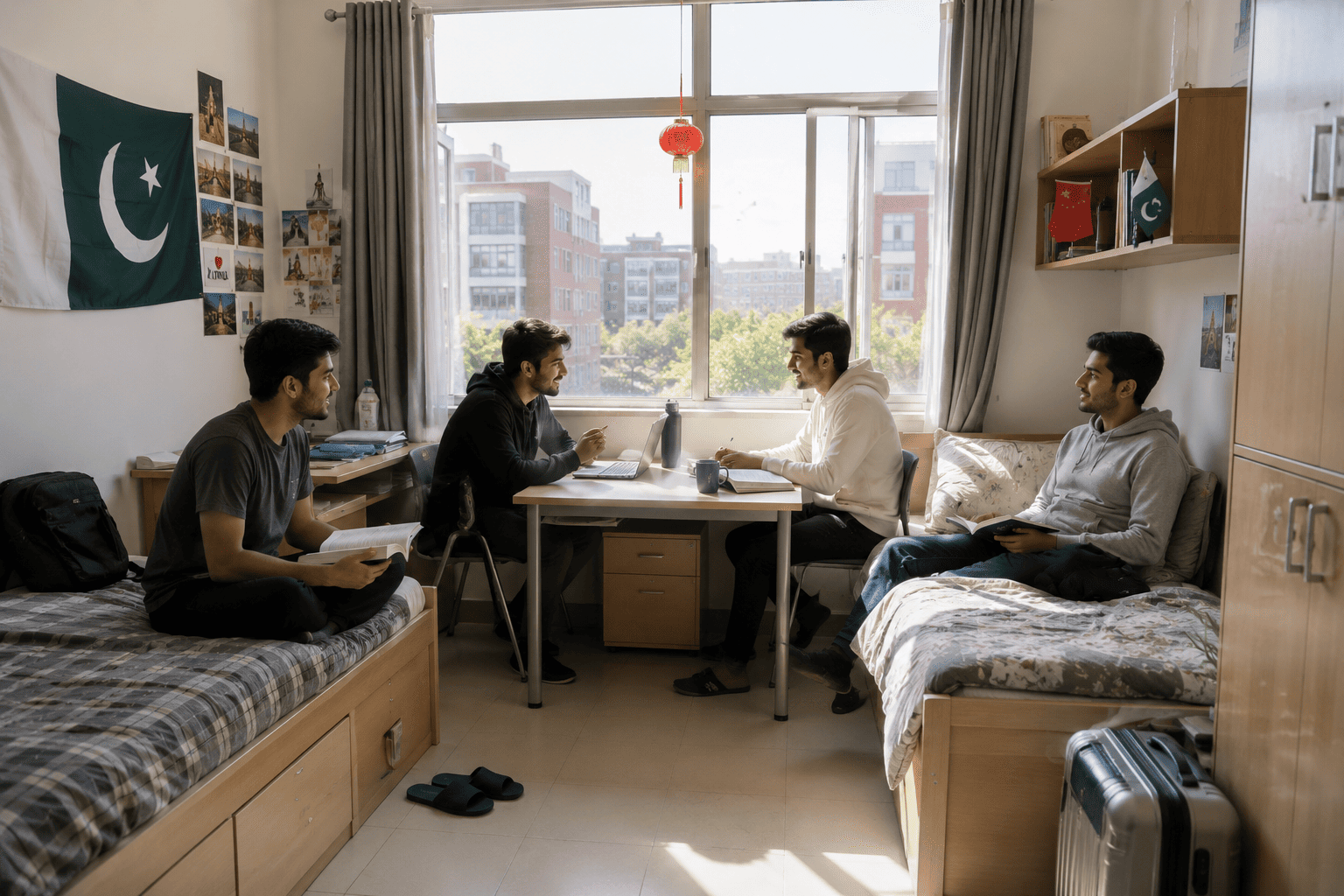
One of the questions almost every parent asks before sending their child to China for MBBS is simple: where will they actually live. Fees and PMDC recognition get most of the attention in blogs and consultant meetings, but day to day life happens in a dorm room, and that’s what shapes the entire experience for six years. This post is about what accommodation actually looks like for Pakistani students in China, what it costs, what daily life feels like, and a few things people don’t tell you until you’re already there.
On Campus Hostels Are the Default, Not the Exception
Almost every Chinese medical university that admits international students runs its own on campus hostel system, and for Pakistani students it’s basically the default option. You won’t be scrambling to find a landlord in a foreign country the way you might in the UK or Australia. The university assigns you a room before you even arrive, and fees are paid as part of your yearly package along with tuition, so you won’t have to worry about finding a place to stay during your first year.
The rooms are shared, with two or three students per room, although sometimes, particularly older universities or cheaper options, there may be more. In any case, the room has at least a bed, a desk and chair, a wardrobe or cupboard, central heating, air conditioning, en suite or shared bathrooms and wifi. At most, they are well secured, with guards, card access and/or strict curfews for women.
The fees for the dorms vary between roughly 500 to 1500 USD per year, with a large difference between cities and universities. First tier cities and more prestigious MOE listed universities will command the higher prices, while smaller universities in provinces like Henan or Ningxia will be much cheaper. Some scholarships, including CSC and CPEC scholarships offered to Pakistani students, include free on campus accommodation as part of the package, which is one more reason it’s worth applying for scholarships even if you think your chances are average.
Single, Double, Triple: What to Actually Expect
Most universities offer a choice between single rooms, double sharing, and triple or group sharing, with price increasing as privacy increases. A lot of first year Pakistani students go for triple sharing simply because it’s cheaper and because sharing with a couple of Pakistani or Muslim roommates makes the first year of homesickness a lot more bearable. By second or third year, once people have settled in, adapted to the routine, and made some local friends, some people choose to get a single room (if budget allows) for having more space for study time before major exams.
If being able to have privacy is a priority for you or you know yourself to be more of an independent worker, ask the admissions office about single room availability and prices for the university you’re applying for, as these differ greatly from person to person.
Food and Halal Options
This is probably the single biggest daily life concern for Pakistani families, and thankfully it’s less of a problem than most people assume. Cafeterias exist right on campus, usually just a few minutes walk from the hostel, and most universities with a meaningful international student population have a dedicated Muslim or halal canteen section. Some campuses may even have a small Pakistani owned shop or restaurant nearby, catering to the local Muslim and South Asian student population.
However, it is important to note that cooking in your room is often either prohibited or heavily restricted for fire safety reasons. For someone whose pleasure it is to cook their own food or make chai at odd hours of the day, this can be a major con. Some hostels may permit use of a common kitchen on specific floors, so it’s best to enquire about this beforehand for your particular university, rather than assuming.
The Off Campus Option
However, not all students choose to live in the university hostel all the time. Some individuals, more often by their third or fourth year, decide to move out and start living in private rented houses or flats with their friends or alone. Those students prefer to do so because they feel more comfortable and independent, having their own place to come back to and be free to use as they see fit, without any control or interference from the university.
The off-campus rent varies depending on the city. Tier one cities like Beijing or Shanghai charge significantly more than smaller provincial cities where a lot of MBBS programs are actually based. Roughly speaking, off campus housing can run anywhere from about 1,000 to 2,500 US dollars a year, sometimes more in expensive cities, and that’s before utilities and food.
The upside is privacy and a quieter, more independent living situation, which some students genuinely need for focused studying in the later, more intense clinical years. The downside is that you’re now responsible for your own safety, your own bills, dealing with a landlord in a language you may not speak fluently, and generally navigating things without the built in support system of the university hostel staff. Most consultants and even universities will tell you it’s smarter to stay on campus for at least the first year or two before considering this move.
What Nobody Really Tells You
A few things that don’t usually make it into the glossy admission brochures. Winters in northern Chinese cities, where a lot of medical universities are located, get genuinely cold, and hostel heating quality varies, so packing proper warm clothing and checking your specific university’s climate before you go matters more than people think. Homesickness in the first few months is real and common, and having even one or two Pakistani roommates or seniors nearby makes a noticeable difference to how that first semester feels.
Hostel curfew timings exist at most universities, particularly for female students, and while they’re meant for safety, they do take some adjusting to if you’re used to a more flexible routine back home. Internet access is generally fine for study purposes, but be aware that certain apps and websites common in Pakistan may require a VPN to access, and this is worth sorting out before you land rather than scrambling for it in your first week.
Laundry facilities exist in most hostels, usually coin operated or card operated machines on each floor, so it’s rarely a major issue, but budgeting a small monthly amount for this is sensible.
A Quick Word of Advice
Before finalizing which university to go with, actually ask to see photos or videos of the specific hostel building your batch will be placed in, not just generic campus photos from the university’s marketing material. Ask current students, preferably those that you have determined to be genuine, about the food, the heating, the roommate situation, and overall atmosphere of the hostel rather than simply relying on information from a consultant. Your hostel experience will dictate your comfort for the next six years, and a little extra homework can make all the difference in how easy an MBBS in China can be from day one.
At the end of the day, accommodation in China for Pakistani MBBS students is genuinely one of the more reassuring parts of the whole journey. It’s organized, it’s included in your budget, and there’s usually a built-in community of fellow Pakistani and Muslim students to lean on. The key is going in with realistic expectations rather than assuming it will feel exactly like home, because it won’t, but for most students it becomes comfortable enough within the first year to stop thinking about it altogether and just focus on the actual degree.