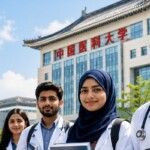
Study in China is a choice for students from other countries like those, from Pakistan and India. China has a lot of universities that offer low tuition fees, nice facilities and degrees that are recognized all around the world. Students like to study medicine, engineering and business in China.
People forget about the costs that people will have to pay for the things they buy. The costs of these things can really add up. That is something that people should think about when they are spending their money. The extra costs can be a lot and people should remember that they have to pay the costs.They have to think about them. Affect how much money they have.
In this blog, we will explain all the important hidden costs so you can make a smart and informed decision before applying.
Accommodation Costs Beyond Tuition
A lot of students think that a place to stay is included or very cheap in China.. The truth is, university dorms are not that expensive, they are okay to pay for. University dorms are affordable. The cost is not always as low as students expect when they are looking for a place to stay in university dorms, in China.
What you should know:
- The cost of living in university dorms is pretty affordable. It can be between RMB 6,000 to RMB 12,000 per year.
- Private apartments are a thing. They can be really expensive in big cities like Beijing, Shanghai , or Guangzhou. University dorms are one thing. Private apartments are a whole different story.
- Some universities require advance payment for the full year
Hidden issue:
Dorm rooms usually need a security deposit. You also have to pay fees for things, like maintenance and utilities. These include electricity, water and the internet. The admission offer doesn’t always show these costs.
2.Food and Daily Living Expenses
Food is a part of what students spend money on and they usually do not think it will cost that much. University cafeterias are not that expensive. Food can get really expensive if you eat outside or cook food on your own.
The cost of food every month is different depending on where you have your food.
- If you have Food at the University cafeteria the Food cost is around RMB 800 to RMB 1,500.
- If you have Food outside or you go to restaurants to have Food the Food cost can be RMB 1,500 to RMB 3,000 or even more, than that for Food.
Hidden costs:
- Kitchen access may not be available in dorms
- Buying cooking tools, utensils, and groceries adds extra cost
- Buying halal food that is imported which’s for Muslim students can be very expensive.
Over time these small costs for halal food add up. Become a big part of your monthly budget, for halal food.
Health Insurance and Medical Fees
All international students studying in China must obtain health insurance. Many students ignore this cost during planning.
Important points:
- Mandatory insurance costs around RMB 600 – 1,200 per year
- Some universities include it in admission, but many do not
- It may not cover all treatments in private hospitals
Hidden issue:
If you go to a hospital without insurance the medical bills can be really expensive.Even just talking to a doctor can cost a lot more than you think it will.
Visa Renewal and Residence Permit Fees
Your student visa (X1 visa) is not permanent. After arriving in China, you must convert it into a residence permit.
Costs include:
- When you apply for a residence permit it will cost you around RMB 400 to RMB 800 every year.
- You will also need to get a check-up in China, which can cost between RMB 300 and RMB 600.
- Then there are some costs for things, like passport photos translating documents and getting them notarized.
Hidden issue:
Many students are not told that these fees are repeated every year or every time they renew their residence permit.
5.Textbooks and Academic Materials
When you are at university the fees you pay do not always cover the cost of books or the things you need to learn. You have to buy the textbooks and academic materials yourself which can be expensive. University fees usually do not include these things, like books or learning materials.
Expected costs:
- Medical textbooks can be expensive (RMB 500 – 2,000 per semester)
- Printing assignments and photocopying notes
- Lab coats, instruments, and other required materials for science and medical students
Hidden issue:
Some universities require specific foreign textbooks that are not easily available locally, increasing costs further.
Travel and transportation costs
China is really big. That means getting around can cost a lot of money that you do not see coming.
Common travel costs:
- Metro or Subway costs around 2 to 10 RMB for each trip.
- I think the bus is really affordable.
- The bus fare is from 1 to 5 RMB, for each trip.
- If you take a Taxi or use ride-hailing apps it will cost more if you are going a way.
- Sometimes you need to travel by Air between cities like when you’re going on holiday or there is an emergency.
Hidden issue:
Students who live away from school have to pay a lot each month just to get to classes. The cost of commuting is a deal, for these students. They spend a lot of money on commuting every month.
Language Learning Expenses
Learning Chinese is really important for life. Chinese, which is also called Mandarin, is useful for things. For example, Chinese is useful for internships. Chinese is also useful for part-time work opportunities. . Chinese is a thing to know even if you are using a program that is in English. You will find that knowing Chinese helps you a lot, in your life and when you are looking for internships or part-time work.
Possible costs:
- I want to learn the language. The cost of Chinese language classes is one thousand to five thousand Chinese dollars, for one semester.
- Online courses or private tutors
- Language exam fees (HSK certification)
Hidden issue:
Without Mandarin skills, students may struggle with daily communication, leading to extra dependency on paid services or translators.
Part-Time Work Limitations
Many students expect to earn money through part-time jobs, but China has strict rules.
Important facts:
- International students are not allowed to work freely
- Work permits are required and not easy to obtain
- Most universities restrict part-time employment
Hidden issue:
Because students cannot rely on income, they must fully depend on their savings or family support, which increases financial pressure.
Climate Adaptation and Clothing costs
China has lots of kinds of weather in different places. The weather in China can be really extreme. Many students who go to China are not ready for this kind of weather. China can be very cold or very hot depending on where you’re in China.
Example:
- Northern China is really cold in the winter. The temperature can go down to -10°C , even lower.
- Southern China is very humid when it is summer.
Hidden costs:
- Buying winter jackets and warm clothes
- Seasonal clothing upgrades are an idea.
- Heating and cooling costs can be high.
Communication and Internet costs
Staying connected with loved ones matters, but there are extra costs for communication in China.
Expenses include:
- Local SIM cards and mobile plans: RMB 50 – 200 per month
- VPN services (for accessing blocked websites)
- International calling or roaming charges
Hidden issue:
Lots of students do not know that things like WhatsApp or Google services are not allowed so they might need to use tools.
University Administrative and Miscellaneous Fees
Apart from tuition, universities may charge different administrative fees.
Examples:
- Registration fees
- Library access fees
- Laboratory usage fees
- Graduation fees
- Exam retake fees
Hidden issue:
These costs are often not clearly mentioned in the admission letter but appear during the academic year.
Emergency and Unexpected Costs
Life abroad always includes unexpected expenses.
Examples:
- Emergency medical treatment
- I need to buy flight tickets when my family has an emergency.
- I also need help when I lose things, like my phone , my passport , or some very important documents.
- Legal or documentation issues
Hidden issue:
Students who do not save money for emergencies often have a time when things get bad. This is because students need money to fall back on when students have expenses. Students who do not have this money can get really worried about how students will pay for things. Students should try to save money each month so students have it when they need it.
Final
I think studying in China is a good chance for international students. This is because China has education that’s easy on the wallet and universities that are very good.. If you only think about how much tuition costs you might get some big financial surprises.
You should know about the costs of studying in China so you can plan better and not worry so much later. Studying in China has a lot of costs like a place to live and food and insurance and travel. Every one of these costs is important for studying in China.