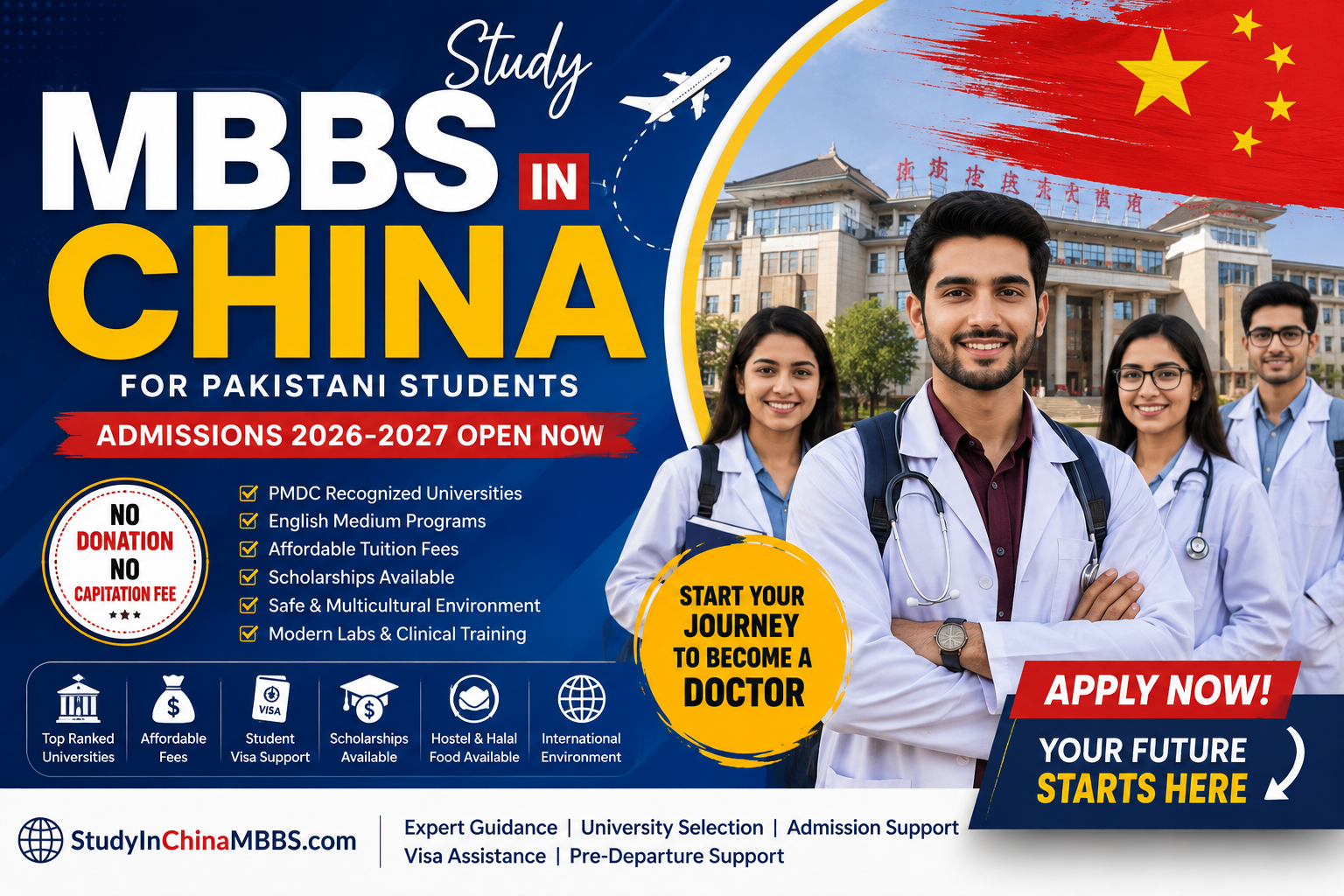
Pursuing an MBBS in China for Pakistani students has become one of the most trusted and affordable pathways to earning an internationally recognized medical degree. With globally ranked medical universities, English-medium MBBS programs, modern teaching hospitals, and competitive tuition fees, China continues to attract thousands of Pakistani students every year who want to build successful careers in medicine.
At StudyInChinaMBBS.com, we specialize in helping Pakistani students secure admission to leading Chinese medical universities. From choosing a university that matches your academic profile to guiding you through the admission process, student visa application, and pre-departure preparations, our experienced advisors provide personalized support at every stage of your journey.
Whether you have recently completed your FSc (Pre-Medical) or are exploring affordable alternatives to studying medicine in Pakistan, we provide clear and up-to-date information about PMDC-recognized medical universities, tuition fees, scholarships, eligibility criteria, hostel facilities, and student life in China. Our goal is to help you make informed decisions with complete transparency and confidence.
With years of experience in international medical admissions and partnerships with reputable Chinese universities, we are committed to making your transition from Pakistan to China as smooth and stress-free as possible.
Begin Your MBBS Journey in China with Confidence
Choosing the right university is one of the most important decisions for your future medical career. Our team helps Pakistani students throughout the entire admission process, including:
- Admission to recognized Chinese medical universities
- University selection based on your academic profile and budget
- Guidance for PMDC-recognized MBBS programs
- Student visa documentation and application support
- Scholarship and tuition fee guidance
- Pre-departure counseling and travel assistance
- Ongoing support after you arrive in China
Whether your goal is to become a doctor in Pakistan or pursue international career opportunities after graduation, studying MBBS in China can provide a strong academic foundation and valuable global exposure.
Start your journey today by exploring the best MBBS opportunities in China for Pakistani students and take the first step toward a successful medical career.
Why Study MBBS in China?
Every year, thousands of Pakistani students choose China as their preferred destination for pursuing an MBBS degree. The combination of internationally recognized medical universities, affordable tuition fees, modern healthcare facilities, and globally accepted qualifications has made China one of the leading destinations for medical education.
For many students in Pakistan, gaining admission to a local medical college can be highly competitive due to limited seats and increasing educational costs. Chinese medical universities offer an excellent alternative by providing quality education, practical clinical training, and internationally recognized degrees at a more affordable cost.
In addition to academic excellence, students benefit from a multicultural learning environment, advanced research opportunities, and access to some of Asia’s largest teaching hospitals. These advantages prepare graduates for medical licensing examinations and future career opportunities in Pakistan and many other countries.
Whether your goal is to practice medicine in Pakistan, pursue postgraduate education abroad, or build an international medical career, studying MBBS in China provides a strong foundation for long-term success.
Internationally Recognized Medical Universities
One of the main reasons Pakistani students choose China is the global recognition of its medical universities. Many Chinese institutions are listed in internationally respected medical education directories and meet the standards required by various medical regulatory authorities.
Students should always choose universities that are recognized by relevant organizations, including:
- Pakistan Medical and Dental Council (PMDC)
- World Directory of Medical Schools (WDOMS)
- World Federation for Medical Education (WFME)
- Educational Commission for Foreign Medical Graduates (ECFMG), where applicable
- Ministry of Education (China)
Graduating from a recognized university gives students greater confidence when planning licensing examinations, postgraduate education, or future medical careers.
Affordable MBBS Education Compared to Many Countries
One of the biggest advantages of studying MBBS in China is affordability.
Compared with many private medical colleges in Pakistan and medical universities in countries such as the United Kingdom, the United States, and Australia, Chinese universities generally offer competitive tuition fees while maintaining high academic standards.
Students also benefit from reasonable living expenses, making it easier for families to manage the overall cost of medical education.
Typical expenses include:
- Annual tuition fees
- Hostel accommodation
- Food and daily living
- Medical insurance
- Student visa and renewal fees
We’ll explore the complete fee structure in a dedicated section later on this page.
English-Medium MBBS Programs
Many Chinese medical universities offer MBBS programs in English specifically for international students.
This allows Pakistani students to study medicine in a language they are already familiar with while also learning basic Chinese language skills for communicating with patients during clinical training.
English-medium education helps students:
- Understand medical concepts more effectively
- Participate confidently in lectures and practical sessions
- Prepare for international licensing examinations
- Adapt more easily to academic life in China
Learning basic Mandarin alongside medical studies also improves communication during hospital rotations and daily life.
Advanced Teaching Hospitals and Clinical Training
Medical education extends beyond classroom learning.
Chinese universities are affiliated with large teaching hospitals where students gain valuable practical experience under the supervision of experienced medical professionals.
Clinical training allows students to:
- Observe real patient cases
- Develop diagnostic skills
- Practice clinical procedures
- Learn evidence-based medical approaches
- Build confidence before entering professional practice
Exposure to modern healthcare systems and advanced medical technologies strengthens students’ practical knowledge and prepares them for future careers.
Safe and Student-Friendly Environment
Safety is an important consideration for students and parents when choosing to study abroad.
Many Chinese university campuses provide a secure and supportive environment for international students through:
- On-campus accommodation
- International student offices
- Medical facilities
- Campus security services
- Organized student activities
- Cultural exchange programs
These services help Pakistani students adjust more comfortably to life in a new country while focusing on their studies.
Diverse International Student Community
Chinese medical universities welcome students from Pakistan, Bangladesh, Nepal, Africa, the Middle East, and many other regions.
Studying in this multicultural environment allows students to:
- Build international friendships
- Learn from different healthcare perspectives
- Develop communication skills
- Expand professional networks
- Prepare for global healthcare careers
Working alongside students from different countries also encourages collaboration and cultural understanding valuable qualities for future medical professionals.
Opportunities Beyond Graduation
An MBBS degree from a recognized Chinese medical university can open doors to a variety of career paths.
Depending on local licensing requirements, graduates may choose to:
- Return to Pakistan and pursue the required licensing pathway
- Prepare for postgraduate medical education
- Apply for international licensing examinations where eligible
- Explore research and academic opportunities
- Build careers in hospitals, clinics, or healthcare organizations
Choosing the right university and maintaining strong academic performance throughout the program can significantly improve future opportunities.
Why More Pakistani Students Are Choosing China Every Year
Studying MBBS in China is more than an affordable alternative it’s an opportunity to receive quality medical education, gain practical clinical experience, and develop the skills needed for a successful medical career.
With internationally recognized universities, English-medium programs, modern medical facilities, and comprehensive student support, China continues to be one of the most preferred destinations for Pakistani students who want to pursue medicine abroad.
At StudyInChinaMBBS.com, we help Pakistani students navigate every stage of the admission journey from selecting the right university and preparing documents to visa assistance and pre-departure guidance so they can begin their medical education with confidence.
MBBS in China at a Glance
If you’re considering pursuing an MBBS degree abroad, having a clear overview of the program can help you compare your options and plan your academic journey more effectively. China has become one of the most preferred destinations for Pakistani students because it offers internationally recognized medical education, English-medium programs, affordable tuition fees, and modern teaching hospitals.
Before applying, it is important to understand the key aspects of studying MBBS in China, including the course duration, eligibility requirements, estimated expenses, admission intake, and university recognition. The table below provides a quick snapshot of the essential information every Pakistani student should know before starting the admission process.
| Category | Details |
| Course Name | Bachelor of Medicine & Bachelor of Surgery (MBBS) |
| Program Duration | 6 Years (5 Years Academic Study + 1 Year Clinical Internship) (May vary by university) |
| Medium of Instruction | English (with basic Chinese language training for clinical communication) |
| Eligibility | FSc (Pre-Medical) or equivalent with required academic percentage as per university and regulatory requirements |
| Minimum Age | Generally 17 years or above at the time of admission |
| Admission Intake | Usually September Intake (Some universities may have additional intakes depending on regulations) |
| Tuition Fees | Vary by university and city. Affordable compared to many private medical colleges in Pakistan and several other countries. |
| Accommodation | On-campus hostel facilities are available at most universities for international students. |
| Living Expenses | Depend on the city and personal lifestyle, including accommodation, food, transportation, and other daily expenses. |
| Scholarships | Merit-based, provincial, university, and government scholarships may be available for eligible international students. |
| Clinical Training | Conducted in affiliated teaching hospitals with supervised practical experience. |
| University Recognition | Students should choose universities recognized by the relevant educational and medical authorities. |
| Student Visa | International students require a Chinese student visa before traveling to China. |
| Career Opportunities | Graduates can pursue licensing pathways, postgraduate education, research, or healthcare careers, subject to the regulations of the country where they intend to practice. |
Eligibility Criteria for MBBS in China for Pakistani Students
Choosing to study MBBS in China is an exciting step toward a rewarding medical career. Before beginning the admission process, it is essential to understand the eligibility requirements set by Chinese medical universities and the documentation expected from Pakistani applicants.
Although admission criteria may vary slightly between universities, most institutions follow similar academic and regulatory standards for international students. Meeting these requirements early can help you prepare your application confidently and avoid unnecessary delays during the admission process.
At StudyInChinaMBBS.com, we guide Pakistani students through every requirement, ensuring that their applications meet university standards and are submitted accurately.
Academic Requirements
Academic performance is one of the primary factors considered during the admission process.
Most Chinese medical universities require applicants to have successfully completed:
- FSc (Pre-Medical) or an equivalent qualification
- Biology, Chemistry, and Physics as core science subjects
- The minimum academic percentage or grade required by the selected university
- Academic documents issued by recognized educational boards
Different universities may have different admission criteria, so it is important to check the specific requirements before applying.
Students with strong academic records often have access to a wider range of university options and may also qualify for scholarship opportunities offered by selected institutions.
Age Requirements
Applicants must generally meet the minimum age requirement established by the university.
Most medical universities accept students who:
- Are at least 17 years old at the time of admission.
- Meet any maximum age requirements specified by the university, if applicable.
Parents and students should always verify age requirements during the university selection process, as admission policies can differ slightly between institutions.
English Language Requirements
One of the reasons many Pakistani students choose China is the availability of English-medium MBBS programs.
Since the curriculum is taught in English at many universities that admit international students, applicants usually do not need to demonstrate advanced Chinese language proficiency before admission.
Instead, universities generally expect students to:
- Have a reasonable understanding of English.
- Be able to follow lectures, practical sessions, and academic coursework.
- Participate in classroom discussions and examinations conducted in English.
Many universities also include basic Chinese (Mandarin) language training during the program to help students communicate effectively with patients during clinical rotations and daily life in China.
Medical Fitness Requirements
Students planning to study abroad should be physically fit to complete their medical education.
Most universities require applicants to submit a medical fitness certificate confirming that they are medically suitable for overseas study.
The medical examination may include:
- General physical examination
- Blood tests (as required)
- Chest examination
- Vaccination or health records, where applicable
Completing the required medical examination before applying helps ensure a smoother admission and visa process.
Valid Passport Requirement
A valid passport is essential for international admission.
Applicants should ensure that their passport:
- Is valid for the required duration.
- Matches the information provided in all admission documents.
- Has sufficient validity for the student visa application process.
If a passport is close to expiration, it is advisable to renew it before beginning the application process.
Required Educational Documents
To process an MBBS application successfully, universities generally request educational documents that verify the applicant’s academic background.
These commonly include:
- Secondary School Certificate (SSC/Matric) or equivalent
- Higher Secondary School Certificate (HSSC/FSc Pre-Medical) or equivalent
- Academic transcripts or mark sheets
- Passport copy
- Passport-size photographs
- Other documents requested by the selected university
Submitting complete and accurate documentation helps prevent delays during the admission review.
A detailed checklist of all required documents is provided in the Required Documents section later on this page.
Eligibility for Pakistani Students
Pakistani students should also consider the academic and professional requirements relevant to their future career plans.
Before selecting a university, students are encouraged to verify:
- Whether the university is recognized by the relevant educational authorities.
- The university’s eligibility for graduates who intend to continue their medical careers after completing their studies.
- The latest admission and regulatory requirements applicable to Pakistani students.
Choosing a well-recognized university from the beginning can make future licensing and career planning much easier.
Our experienced admission counselors assist students in selecting universities that align with both their educational goals and long-term professional aspirations.
Additional Factors Universities May Consider
While academic qualifications are the primary requirement, universities may also review additional information during the admission process, such as:
- Overall academic consistency
- Personal statement (where required)
- Interview or online assessment (for selected universities)
- Compliance with international student admission policies
Preparing these requirements in advance can improve the application experience and reduce unnecessary delays.
How StudyInChinaMBBS.com Helps You Meet the Eligibility Requirements
Understanding admission requirements can feel overwhelming, especially when applying to universities in another country.
At StudyInChinaMBBS.com, we provide personalized guidance to help Pakistani students:
- Evaluate their eligibility before applying.
- Select universities that match their academic qualifications.
- Review educational documents before submission.
- Prepare complete admission applications.
- Receive support throughout the admission and visa process.
Our goal is to make the journey from Pakistan to a recognized Chinese medical university as straightforward and stress-free as possible.
Ready to Check Your Eligibility?
If you’re planning to pursue MBBS in China, the first step is understanding whether you meet the admission requirements for your preferred university.
Our experienced admission advisors can assess your academic profile, explain the eligibility criteria, and recommend suitable universities based on your qualifications, budget, and career goals helping you begin your medical education with confidence.
MBBS in China Admission Process for Pakistani Students
Applying for an MBBS in China may seem challenging at first, but the process becomes much easier when you understand each step and prepare the required documents in advance. Chinese medical universities follow a structured admission process for international students, and with proper guidance, Pakistani applicants can complete their applications smoothly and confidently.
At StudyInChinaMBBS.com, we assist students throughout the entire admission journey from selecting the right university to arriving safely in China. Our experienced admission counselors ensure that every application is prepared accurately, helping students avoid common mistakes and unnecessary delays.
Below is a step-by-step guide to the MBBS admission process for Pakistani students.
Step 1: Book a Free Admission Consultation
The first step is understanding your educational background, career goals, and budget before selecting a medical university.
During the consultation, our admission experts help you:
- Assess your academic eligibility
- Understand admission requirements
- Explore PMDC-recognized medical universities in China
- Compare tuition fees and living costs
- Shortlist universities based on your preferences
Choosing the right university at the beginning helps simplify the rest of the admission process.
Step 2: Choose the Right Medical University
Not every medical university is the same. Each institution has its own admission criteria, tuition fees, campus facilities, and student support services.
When selecting a university, consider factors such as:
- University recognition and accreditation
- English-medium MBBS program availability
- Academic reputation
- Clinical training opportunities
- Hostel facilities
- Tuition fees and living expenses
- City location and climate
- International student support
Our counselors help Pakistani students compare universities objectively so they can make informed decisions based on their academic profile and future career plans.
Step 3: Prepare and Submit Your Documents
Once you’ve selected your preferred university, the next step is preparing your application documents.
Most universities require documents such as:
- Valid passport
- SSC (Matric) certificates
- HSSC/FSc (Pre-Medical) certificates
- Academic transcripts
- Passport-size photographs
- Medical examination report
- Police clearance certificate (if required)
- Any additional documents requested by the university
Submitting complete and accurate documents helps universities process applications more efficiently.
Before submission, our team carefully reviews every document to minimize errors and ensure compliance with university requirements.
Step 4: Receive Your Admission Letter
After your application has been reviewed and approved, the university issues an official admission letter confirming your acceptance into the MBBS program.
Depending on the university, students may also receive additional admission documents required for the student visa application.
Receiving your admission offer is an important milestone, as it confirms your place at the university and allows you to move forward with the visa process.
Step 5: Apply for Your Chinese Student Visa
After receiving your admission documents, you can begin the student visa application process.
This typically involves:
- Completing the visa application form
- Preparing required supporting documents
- Submitting your passport and admission documents
- Completing any required medical examinations
- Attending visa appointments if necessary
Visa requirements may change over time, so students should always follow the latest guidance issued by the relevant Chinese authorities.
Our advisors assist students in preparing their visa documentation to help ensure a smooth application process.
Step 6: Prepare for Departure
Once your student visa has been approved, it’s time to prepare for your move to China.
Before traveling, students should:
- Confirm their travel itinerary
- Arrange accommodation if required
- Prepare essential documents
- Organize personal belongings
- Understand university reporting dates
- Learn about local culture and campus life
Proper planning before departure reduces stress and helps students adjust more comfortably after arriving in China.
Our pre-departure guidance provides practical information to help students feel confident before beginning their studies abroad.
Step 7: Arrive in China and Complete University Registration
Upon arrival, students complete the final university registration process.
This generally includes:
- Reporting to the university
- Verification of original documents
- Hostel check-in
- Medical registration (if required)
- Student ID issuance
- Orientation programs
- Class registration
Orientation sessions introduce students to campus facilities, academic expectations, university regulations, and student support services, making it easier to settle into university life.
Common Mistakes to Avoid During the Admission Process
Many admission delays occur because students make avoidable mistakes during their applications.
Some common issues include:
- Choosing a university without understanding its admission requirements
- Submitting incomplete or incorrect documents
- Waiting until the last minute to apply
- Providing inconsistent information across documents
- Not checking passport validity
- Missing important application or visa deadlines
Planning ahead and seeking professional guidance can help prevent these problems and make the admission process much smoother.
Why Apply Through StudyInChinaMBBS.com?
Applying through an experienced admission consultancy provides students with expert guidance throughout every stage of the process.
At StudyInChinaMBBS.com, we help Pakistani students by providing:
- Personalized university selection
- Admission eligibility assessment
- Complete application assistance
- Document verification and review
- Student visa guidance
- Pre-departure counseling
- Continued support after arrival in China
Our objective is to simplify the admission process while helping students make informed decisions about their medical education.
Start Your MBBS Admission Journey Today
The admission process for studying MBBS in China doesn’t have to be complicated. With the right preparation and expert guidance, Pakistani students can complete each step with confidence and focus on achieving their dream of becoming medical professionals.
Whether you’re exploring university options or ready to submit your application, StudyInChinaMBBS.com is here to support you from your first consultation to your first day on campus.
Required Documents for MBBS in China Admission
Preparing the correct documents is one of the most important steps in the MBBS in China admission process. Even if you meet the academic eligibility requirements, missing or incorrect documentation can delay your application or affect the admission timeline.
Most Chinese medical universities follow a standard documentation process for international students. However, specific requirements may vary depending on the university, so it’s always recommended to verify the latest document checklist before submitting your application.
At StudyInChinaMBBS.com, we help Pakistani students review, organize, and submit their documents accurately to ensure a smooth and hassle-free admission experience.
Academic Documents
Your academic records are the foundation of your MBBS application. Universities evaluate these documents to confirm that you meet the educational requirements for admission.
Pakistani students are generally required to provide:
- Secondary School Certificate (SSC/Matric) or equivalent
- Higher Secondary School Certificate (HSSC/FSc Pre-Medical) or equivalent
- Official academic transcripts or mark sheets
- Any additional educational certificates requested by the university
Before submission, ensure that all academic documents are complete, legible, and consistent with your passport information.
Valid Passport
A valid passport is required throughout the admission and visa process.
Your passport should:
- Be valid for the required period
- Match the personal information provided in your application
- Have sufficient validity for student visa processing
If your passport is due to expire soon, renewing it before starting the admission process can help avoid unnecessary complications.
Passport-Size Photographs
Most universities request recent passport-size photographs for admission records and official documentation.
Students should prepare multiple photographs that:
- Meet the university’s required specifications
- Have a plain background
- Clearly show the applicant’s face
- Are recent and of good quality
Digital copies may also be required during the online application process.
Medical Examination Report
International students are generally required to submit a medical examination report confirming that they are medically fit to study abroad.
Depending on university and visa requirements, the examination may include:
- General physical examination
- Blood tests (where required)
- Chest examination
- Basic health assessment
- Vaccination records, if requested
Completing the medical examination through an authorized healthcare provider helps ensure your documents are accepted without delays.
Police Clearance Certificate
Some Chinese medical universities or visa authorities may require applicants to provide a Police Clearance Certificate (PCC).
This document confirms that the applicant has no serious criminal record and meets the eligibility requirements for international study.
Students should check whether this document is required by their selected university before preparing their application.
Admission Application Form
Every university requires students to complete an official admission application form.
The application should include accurate information regarding:
- Personal details
- Academic qualifications
- Contact information
- Preferred program
- Passport details
Providing accurate information throughout the application helps prevent processing delays.
Before submission, carefully review all information to ensure consistency across every document.
English Language Requirements
Many Chinese universities offering English-medium MBBS programs do not require international students to submit standardized English language test scores.
However, applicants should be able to:
- Understand English-language lectures
- Communicate effectively during academic activities
- Complete coursework conducted in English
Individual universities may have different admission policies, so applicants should always review the specific language requirements of their chosen institution.
Financial Documents (If Required)
Some universities or visa authorities may request evidence that students have sufficient financial resources to support their education and living expenses in China.
Depending on individual circumstances, requested documents may include:
- Bank statements
- Financial sponsorship documents
- Affidavits of support
- Other financial records
Preparing these documents in advance can help speed up the visa application process if they are requested.
Additional Documents Depending on the University
Certain medical universities may request additional documentation based on their admission policies.
These may include:
- Personal statement
- Study plan
- Recommendation letters
- Birth certificate
- Character certificate
- Any university-specific forms
Since document requirements can vary, applicants should always follow the official checklist provided by their selected university.
Document Checklist for Pakistani Students
Before submitting your MBBS application, make sure you have prepared the following:
✔️ Valid Passport
✔️ SSC (Matric) Certificate
✔️ HSSC/FSc (Pre-Medical) Certificate
✔️ Academic Transcripts
✔️ Passport-Size Photographs
✔️ Medical Examination Report
✔️ Police Clearance Certificate (if applicable)
✔️ Completed University Application Form
✔️ Financial Documents (if required)
✔️ Additional University-Specific Documents
Keeping both printed and digital copies of all documents is recommended throughout the admission and travel process.
Tips to Avoid Document-Related Delays
Many admission applications are delayed because of simple documentation errors. Before submitting your application:
- Verify that all information matches your passport.
- Ensure documents are clear, complete, and properly scanned.
- Submit documents before application deadlines.
- Follow the document format requested by the university.
- Keep backup copies of every document.
- Respond promptly if the university requests additional information.
A well-prepared application increases the chances of faster admission processing.
How StudyInChinaMBBS.com Helps with Documentation
Preparing admission documents can feel overwhelming, especially for first-time international applicants. Our experienced admission counselors assist Pakistani students throughout the documentation process by:
- Reviewing application documents before submission
- Explaining university-specific document requirements
- Helping organize educational records
- Providing guidance on medical and visa documentation
- Assisting with application preparation from start to finish
Our goal is to help students submit accurate, complete applications while reducing the risk of delays or missing paperwork.
Prepare Your Documents with Confidence
Having the right documents ready before applying can make your admission process much smoother. Whether you’re applying to your first-choice university or comparing multiple options, careful preparation is the key to a successful application.
At StudyInChinaMBBS.com, we support Pakistani students at every stage of the admission journey, ensuring that all required documents are properly prepared so they can focus on achieving their dream of studying MBBS in China.
MBBS in China Fees for Pakistani Students
One of the biggest reasons Pakistani students choose China for their medical education is the opportunity to earn an internationally recognized MBBS degree at a more affordable cost than many other study destinations. While tuition fees vary between universities, studying MBBS in China generally offers excellent value when considering the quality of education, modern campus facilities, experienced faculty, and clinical training available.
Understanding the complete cost of studying abroad is essential before applying. In addition to tuition fees, students should also plan for accommodation, living expenses, medical insurance, visa-related costs, and other personal expenses.
At StudyInChinaMBBS.com, we help Pakistani students compare universities based on both academic quality and affordability, allowing them to make informed financial decisions before beginning the admission process.
Understanding the Total Cost of MBBS in China
The overall cost of studying MBBS in China is made up of several components. While tuition fees are often the largest expense, students should consider all aspects of their education and daily living to create a realistic budget.
The total cost may include:
- Annual tuition fees
- University hostel accommodation
- Food and daily living expenses
- Medical insurance
- Student visa and residence permit fees
- Medical examination charges
- Airfare and travel expenses
- Personal and academic supplies
Planning for these expenses in advance allows students and their families to manage finances more effectively throughout the course.
Tuition Fees
Tuition fees vary depending on the university, its location, facilities, and reputation.
Factors that influence tuition fees include:
- Government or public university status
- City where the university is located
- English-medium MBBS program
- Campus facilities
- Research and teaching infrastructure
- International student services
Although fees differ from one university to another, many Chinese medical universities remain significantly more affordable than private medical colleges in Pakistan and medical schools in several Western countries.
Instead of focusing solely on the lowest tuition fee, students should also evaluate:
- University recognition
- Academic reputation
- Clinical training opportunities
- Graduate outcomes
- Student support services
Choosing the right balance between affordability and educational quality is important for long-term success.
Hostel and Accommodation Costs
Most Chinese medical universities provide dedicated hostel facilities for international students.
University accommodation typically offers:
- Furnished rooms
- Internet access
- Study areas
- Laundry facilities
- Campus security
- Easy access to classrooms and teaching hospitals
Hostel costs vary depending on:
- Room type
- Number of occupants
- University location
- Available facilities
Living on campus is often a convenient option for first-year international students, providing a safe and supportive environment while adjusting to life in China.
Food and Daily Living Expenses
Daily living expenses depend largely on the student’s lifestyle and the city where they study.
Typical monthly expenses may include:
- Meals
- Groceries
- Transportation
- Mobile phone services
- Internet
- Personal care
- Entertainment
- Study materials
Many universities have affordable cafeterias offering a variety of meal options, while larger cities provide access to international restaurants, supermarkets, and Pakistani or halal food in many locations.
By budgeting carefully, students can comfortably manage their monthly expenses throughout their studies.
Medical Insurance
Medical insurance is generally required for international students studying in China.
Health insurance helps cover eligible medical expenses during the student’s stay and provides additional peace of mind for both students and their families.
Universities usually provide guidance regarding approved insurance plans during the admission or registration process.
Students should ensure they understand:
- Coverage limits
- Hospital network
- Emergency services
- Claim procedures
Having appropriate insurance is an important part of preparing for overseas education.
Student Visa and Residence Permit Costs
Pakistani students planning to study in China must obtain the appropriate student visa before traveling.
After arriving in China, students may also need to complete residence permit formalities according to local regulations.
Associated costs can include:
- Student visa application
- Residence permit processing
- Required documentation
- Administrative fees
Requirements may change over time, so applicants should always follow the latest official guidelines during the admission process.
Medical Examination and Registration Fees
Some universities require students to complete medical examinations either before departure or after arrival in China.
Additional registration-related expenses may include:
- Health examinations
- University registration
- Student identification cards
- Orientation activities
These costs are generally one-time expenses during the admission process.
Airfare and Travel Expenses
Travel costs vary depending on:
- Departure city in Pakistan
- Destination city in China
- Time of booking
- Airline selection
- Seasonal demand
Students are encouraged to book flights early once their admission and visa process is complete to secure more economical travel options.
Planning travel arrangements in advance also helps avoid last-minute stress before departure.
Scholarship Opportunities Can Help Reduce Costs
Many Chinese universities and educational authorities offer scholarship opportunities to eligible international students.
Depending on the university, scholarships may be available through:
- Government-funded programs
- Provincial scholarships
- University scholarships
- Merit-based awards
- International student scholarship schemes
Eligibility requirements vary between institutions and scholarship programs.
Our admission counselors help students identify universities that may offer financial assistance based on their academic background and eligibility.
A dedicated section on scholarships is provided later on this page.
Tips for Managing Your Study Budget in China
Proper financial planning allows students to focus on their education without unnecessary financial pressure.
Some practical budgeting tips include:
- Research university fees before applying.
- Estimate monthly living expenses realistically.
- Keep emergency funds available.
- Compare accommodation options carefully.
- Track daily spending.
- Take advantage of student facilities and campus services.
- Plan annual expenses before each academic year.
Creating a realistic financial plan before departure helps students manage their studies more comfortably.
Choosing Value Over the Lowest Cost
While affordability is an important factor, selecting a university based only on the lowest tuition fee is not always the best decision.
Pakistani students should also consider:
- University recognition
- Academic quality
- Clinical training facilities
- Teaching hospital affiliations
- Student support services
- Graduate success
- Campus safety
- Overall learning environment
Investing in a recognized medical university can provide greater academic and career opportunities after graduation.
How StudyInChinaMBBS.com Helps You Compare MBBS Costs
Comparing universities, tuition fees, and living expenses can be confusing, especially when every institution offers different facilities and admission packages.
At StudyInChinaMBBS.com, we help Pakistani students:
- Compare tuition fees across multiple universities.
- Understand the complete cost of studying MBBS in China.
- Explore scholarship opportunities.
- Estimate accommodation and living expenses.
- Choose universities that match both their budget and academic goals.
Our experienced advisors provide transparent guidance so students can make informed financial decisions before applying.
Plan Your MBBS Journey with Confidence
Studying MBBS in China is not only an investment in your education but also in your future medical career. By understanding the full cost of studying abroad and planning your finances carefully, you can choose a university that offers both quality education and long-term value.
Whether you’re looking for an affordable English-medium MBBS program or comparing universities based on tuition fees and facilities, StudyInChinaMBBS.com is here to guide you through every step of the admission process.
Estimated MBBS in China Expenses at a Glance
| Expense Category | Typical Cost |
| Tuition Fees | Vary by university and program |
| Hostel Accommodation | Depends on room type and university |
| Food & Living Expenses | Vary by city and lifestyle |
| Medical Insurance | Annual (as required by university) |
| Student Visa | Government processing fee |
| Residence Permit | Applicable after arrival |
| Medical Examination | One-time (if required) |
| Airfare | Depends on travel season and route |
| Personal Expenses | Based on individual lifestyle |
Note: Costs vary between universities and may change from year to year. Always confirm the latest fee structure with your chosen university before submitting your application.
Scholarships for MBBS in China for Pakistani Students
For many Pakistani students, financing an international medical education is one of the biggest concerns when planning to study abroad. The good news is that many Chinese medical universities and educational authorities offer scholarship opportunities that can help reduce the overall cost of studying MBBS in China.
While scholarships may not always cover every expense, they can significantly lower tuition fees or provide financial assistance for eligible international students. The availability, eligibility criteria, and coverage vary depending on the university and scholarship program.
At StudyInChinaMBBS.com, we help students explore available scholarship opportunities, understand the application requirements, and choose universities that align with both their academic achievements and financial goals.
Are Scholarships Available for MBBS in China?
Yes. Many Chinese universities offer scholarships specifically for international students pursuing higher education, including medical programs.
Depending on the university and funding source, scholarships may cover:
- Full or partial tuition fees
- Accommodation support
- Living allowances (for selected programs)
- Academic achievement awards
- International student grants
Since scholarship policies differ from one university to another, students should always verify the latest opportunities before applying.
Chinese Government Scholarships
The Chinese Government Scholarship (CGS) is one of the most recognized scholarship programs available for international students.
It is designed to attract talented students from around the world by supporting higher education in China.
Depending on the scholarship category, benefits may include:
- Tuition fee support
- Accommodation assistance
- Monthly living stipend (where applicable)
- Medical insurance
The number of available scholarships and eligibility requirements may vary each academic year.
Students interested in government-funded scholarships should begin preparing their applications well in advance.
Provincial Government Scholarships
In addition to national scholarship programs, several provincial governments in China offer financial assistance to outstanding international students.
These scholarships are intended to encourage international education and may vary depending on:
- Province
- University
- Academic performance
- Available funding
Provincial scholarships can help reduce tuition costs and make studying in China even more affordable.
University Scholarships
Many Chinese medical universities have their own scholarship programs for international students.
University scholarships may be awarded based on:
- Academic excellence
- Outstanding entrance qualifications
- Merit
- Institutional policies
- International recruitment initiatives
Some universities automatically consider eligible applicants during the admission process, while others require a separate scholarship application.
Understanding each university’s scholarship policy is an important part of choosing the right institution.
Merit-Based Scholarships
Students with strong academic records often have better opportunities to receive merit-based financial assistance.
Universities may evaluate:
- Academic grades
- Entrance qualifications
- Overall educational performance
- Personal achievements
- Scholarship application documents
Although high academic performance does not guarantee a scholarship, maintaining excellent educational records can improve eligibility.
Scholarships for High-Achieving Pakistani Students
Pakistani students with outstanding academic performance may qualify for various scholarship opportunities depending on the university and admission cycle.
Universities often look for applicants who demonstrate:
- Strong science background
- Consistent academic performance
- Commitment to medical education
- Complete and well-prepared application documents
Submitting applications early and ensuring all documents are accurate can improve the overall admission experience.
How to Improve Your Scholarship Opportunities
Competition for scholarships can be high, making careful preparation essential.
Students can strengthen their applications by:
- Applying as early as possible.
- Maintaining strong academic grades.
- Preparing complete documentation.
- Following university application guidelines carefully.
- Selecting universities that actively offer scholarships to international students.
- Seeking professional admission guidance before applying.
Early planning often provides access to a wider range of scholarship opportunities.
Important Things to Know About Scholarships
Before applying, students should understand that every scholarship program has its own terms and conditions.
Scholarships may differ in:
- Eligibility requirements
- Application deadlines
- Duration of funding
- Renewal conditions
- Academic performance requirements
Some scholarships continue throughout the MBBS program if students maintain satisfactory academic progress, while others may require annual renewal based on university policies.
Reading the scholarship guidelines carefully helps students understand their responsibilities after receiving financial assistance.
Choosing the Right University Is Just as Important
While scholarships can reduce educational costs, selecting the right university should remain the top priority.
When comparing universities, Pakistani students should consider:
- University recognition
- Quality of medical education
- Clinical training opportunities
- Faculty experience
- Student support services
- Research facilities
- Tuition fees
- Available scholarships
- Graduate outcomes
The best university is not always the one offering the largest scholarship it is the one that provides the best combination of educational quality, affordability, and long-term career opportunities.
How StudyInChinaMBBS.com Helps Students Find Scholarships
Finding accurate scholarship information can be challenging because funding opportunities change from year to year.
Our experienced admission counselors help Pakistani students:
- Identify universities offering scholarships.
- Understand scholarship eligibility requirements.
- Compare scholarship opportunities across multiple universities.
- Prepare strong admission applications.
- Submit applications within university deadlines.
- Receive guidance throughout the admission process.
Our goal is to help students make informed decisions while maximizing opportunities to reduce the overall cost of studying MBBS in China.
Start Your MBBS Journey with the Right Financial Plan
Scholarships can make studying MBBS in China more affordable, but successful planning begins with choosing the right university and preparing a strong application.
Whether you’re looking for merit-based scholarships, university financial aid, or government-funded opportunities, StudyInChinaMBBS.com is here to guide you through every stage of the admission process from university selection and scholarship guidance to visa assistance and pre-departure support.
With the right advice and preparation, you can take the next step toward earning an internationally recognized medical degree in China while managing your educational expenses more effectively.
Scholarship Options at a Glance
| Scholarship Type | Who Offers It | Possible Benefits |
| Chinese Government Scholarship | Chinese Government | Tuition support, accommodation, living allowance (where applicable), medical insurance |
| Provincial Government Scholarship | Provincial Authorities | Partial or full tuition assistance depending on the province |
| University Scholarship | Individual Universities | Merit-based tuition reductions and institutional financial support |
| Merit-Based Scholarship | Universities | Awarded based on academic performance and eligibility criteria |
Note: Scholarship availability, eligibility criteria, application deadlines, and benefits vary by university and academic year. Applicants should always verify the latest information before applying.
Best Medical Universities in China for Pakistani Students
Choosing the right medical university is one of the most important decisions for students planning to pursue an MBBS in China. While many Chinese universities offer English-medium MBBS programs, they differ in terms of academic reputation, campus facilities, clinical training, tuition fees, student support services, research opportunities, and international recognition.
For Pakistani students, selecting a university should involve more than comparing tuition costs. It is equally important to evaluate factors such as university recognition, teaching quality, affiliated hospitals, campus environment, and long-term career opportunities after graduation.
At StudyInChinaMBBS.com, we help students identify universities that best match their academic qualifications, career goals, and financial plans while providing guidance throughout the admission process.
What Should Pakistani Students Consider When Choosing a Medical University?
Before applying, students should carefully compare universities based on several important factors rather than focusing on rankings alone.
Consider the following:
- Recognition by relevant educational and medical authorities
- Availability of English-medium MBBS programs
- Quality of teaching hospitals and clinical exposure
- Academic reputation and faculty experience
- Tuition fees and overall cost of study
- Hostel accommodation and campus facilities
- International student support services
- Scholarship opportunities
- Safety and location of the university
- Success of international graduates
A well-informed decision can positively impact both your university experience and future medical career.
Ningxia Medical University
Ningxia Medical University has become a popular choice among Pakistani and other international students because of its affordable tuition fees, supportive learning environment, and English-medium MBBS program.
The university offers:
- Modern classrooms and laboratories
- Affiliated teaching hospitals
- International student support services
- On-campus accommodation
- Clinical training opportunities
- Multicultural campus environment
Students appreciate its balance between quality education and affordability, making it an attractive option for aspiring doctors.
Jiangsu University
Jiangsu University is recognized for its strong academic programs, advanced research environment, and modern medical facilities.
Students benefit from:
- Experienced faculty members
- Comprehensive medical curriculum
- Well-equipped laboratories
- Practical hospital-based training
- International student community
- Modern campus infrastructure
Its emphasis on practical learning helps students develop both theoretical knowledge and clinical skills throughout the MBBS program.
Nanjing Medical University
Nanjing Medical University is widely respected for its long-standing contribution to medical education and healthcare research.
Key highlights include:
- High academic standards
- Advanced medical research facilities
- Extensive clinical training opportunities
- Strong teaching hospital network
- International collaborations
- Diverse student population
The university provides an environment that encourages academic excellence while preparing students for professional medical practice.
Zhengzhou University
Zhengzhou University is one of China’s well-known comprehensive universities offering quality medical education to international students.
Students studying here benefit from:
- Large university campus
- Modern teaching facilities
- Clinical exposure through affiliated hospitals
- Experienced teaching staff
- International student services
- Active research environment
Its medical programs combine classroom learning with practical experience to prepare students for future healthcare careers.
Shihezi University
Located in Xinjiang, Shihezi University has gained recognition for providing quality medical education and a welcoming environment for international students.
The university offers:
- English-medium MBBS program
- Affordable education
- Practical clinical experience
- Modern laboratories
- Comfortable student accommodation
- Supportive academic environment
Many Pakistani students appreciate the university’s emphasis on practical learning and student support.
Hebei North University
Hebei North University has become a preferred choice for many international students seeking affordable and recognized medical education.
Its strengths include:
- Experienced academic staff
- Teaching hospital affiliations
- Modern campus facilities
- Student-centered learning
- Clinical practice opportunities
- International student support
The university focuses on developing competent healthcare professionals through both academic instruction and practical training.
Kunming Medical University
Kunming Medical University is known for its medical education, research activities, and clinical training programs.
Students have access to:
- Advanced teaching hospitals
- Modern laboratories
- Comprehensive medical curriculum
- International student services
- Clinical research opportunities
- Supportive learning environment
The university continues to attract students from many countries because of its quality education and practical approach to medicine.
Wuhan University of Science and Technology
Wuhan University of Science and Technology offers a comprehensive MBBS program supported by experienced faculty members and modern medical infrastructure.
Students benefit from:
- Practical clinical education
- Affiliated hospitals
- Research opportunities
- Modern classrooms
- International student community
- Academic support services
Its balanced approach to theoretical education and hands-on medical training prepares students for diverse healthcare careers.
Comparison of Leading Medical Universities in China
| University | English-Medium MBBS | Teaching Hospitals | International Students | Hostel Facilities | Scholarship Opportunities |
| Ningxia Medical University | ✔ | ✔ | ✔ | ✔ | Available |
| Jiangsu University | ✔ | ✔ | ✔ | ✔ | Available |
| Nanjing Medical University | ✔ | ✔ | ✔ | ✔ | Available |
| Zhengzhou University | ✔ | ✔ | ✔ | ✔ | Available |
| Shihezi University | ✔ | ✔ | ✔ | ✔ | Available |
| Hebei North University | ✔ | ✔ | ✔ | ✔ | Available |
| Kunming Medical University | ✔ | ✔ | ✔ | ✔ | Available |
| Wuhan University of Science and Technology | ✔ | ✔ | ✔ | ✔ | Available |
Note: Admission requirements, tuition fees, scholarship availability, and university policies may change over time. Students should always verify the latest information before submitting an application.
How to Select the Right University for Your Career Goals
Every student has different academic strengths, financial circumstances, and long-term career objectives.
When selecting a university, ask yourself:
- Does the university match my academic qualifications?
- Is the university recognized by the appropriate authorities?
- Does it provide quality clinical training?
- Are the tuition fees within my budget?
- Does the campus provide good accommodation and student support?
- Are scholarship opportunities available?
- Does the university align with my future licensing and career plans?
Choosing the right university involves balancing educational quality, affordability, recognition, and future opportunities.
Why Pakistani Students Trust StudyInChinaMBBS.com
Selecting a medical university can feel overwhelming because every institution offers different programs, facilities, and admission requirements.
Our experienced admission advisors simplify this process by helping students:
- Compare leading medical universities in China
- Understand admission requirements
- Review tuition fees and living expenses
- Explore scholarship opportunities
- Select universities based on academic performance and career goals
- Receive complete admission and visa guidance
Rather than recommending a one-size-fits-all solution, we focus on helping each student choose the university that best fits their individual needs.
Find the Right Medical University with Confidence
The university you choose today will shape your medical education, clinical experience, and future career. Taking the time to compare your options carefully can make a significant difference in your academic journey.
At StudyInChinaMBBS.com, we are committed to helping Pakistani students make informed decisions by providing transparent information, expert guidance, and personalized support throughout the admission process.
Whether you are looking for affordability, academic excellence, modern clinical training, or scholarship opportunities, we are here to help you find the medical university that is right for you.
MOE vs Non-MOE Medical Universities in China: What Pakistani Students Should Know
When researching MBBS in China, Pakistani students often come across the terms MOE and Non-MOE universities. Understanding the difference between these two categories is essential before applying, as it can influence your educational experience, international recognition, available resources, and long-term career plans.
Many students mistakenly believe that every medical university in China offers the same quality of education or international support. In reality, universities differ in terms of government approval, infrastructure, English-medium education, international student services, teaching hospitals, and academic reputation.
At StudyInChinaMBBS.com, we help Pakistani students understand these differences so they can make informed decisions when selecting a medical university.
What Does MOE Mean?
MOE stands for the Ministry of Education of the People’s Republic of China.
The Ministry of Education oversees higher education institutions in China and is responsible for regulating educational standards, approving universities, and monitoring the quality of academic programs.
For international students pursuing MBBS, the Ministry of Education also determines which universities are authorized to enroll international students in English-medium MBBS programs, subject to current government policies.
This approval helps ensure that universities meet specific educational and administrative requirements for international medical education.
What Are Non-MOE Universities?
Non-MOE universities are institutions that are not included in the Ministry of Education’s official list for English-medium MBBS admissions for international students.
Some of these universities may still offer medical education and other academic programs. However, they may have different admission policies, language requirements, or international student services.
Before applying, students should carefully verify whether the university is currently authorized to admit international MBBS students and whether its program aligns with their future academic and professional goals.
Why Does the Difference Matter?
Understanding the distinction between MOE and Non-MOE universities helps students avoid confusion during the admission process.
Choosing the right university affects several important aspects of your education, including:
- Availability of English-medium MBBS programs
- International student support
- Teaching hospital access
- Academic resources
- Clinical training opportunities
- Future educational planning
- Overall student experience
Making an informed choice from the beginning can help reduce potential challenges later in your academic journey.
Key Differences Between MOE and Non-MOE Universities
| Feature | MOE Universities | Non-MOE Universities |
| Ministry of Education Approval for International English-Medium MBBS Programs | Yes | May vary depending on university and current regulations |
| English-Medium MBBS Availability | Generally Available | May vary |
| International Student Admission | Well-established | Depends on institutional policies |
| Teaching Hospitals | Usually Extensive | Varies by university |
| International Student Services | Typically Well-Developed | May differ between institutions |
| Campus Facilities | Modern and comprehensive | Depends on the university |
| Clinical Training Opportunities | Strong hospital affiliations | Varies |
| Admission Policies | Clearly structured | University-specific |
Note: Admission policies and university approvals may change over time. Students should always verify the latest information before submitting an application.
Benefits of Choosing an MOE-Listed Medical University
Many Pakistani students prefer MOE-listed universities because they often provide a structured learning environment designed for international students.
Common advantages include:
- English-medium MBBS programs
- Established international student departments
- Modern laboratories and classrooms
- Well-equipped teaching hospitals
- Comprehensive clinical training
- Better administrative support
- Diverse international student community
- Strong academic infrastructure
These factors contribute to a smoother educational experience for students studying away from home.
Can Pakistani Students Study at Non-MOE Universities?
Admission policies vary from one institution to another.
Before considering any university, Pakistani students should carefully verify:
- Current admission eligibility
- Language of instruction
- Recognition status
- Clinical training arrangements
- University accreditation
- Student support services
Rather than relying on outdated information or unofficial sources, students should always seek updated guidance before making an admission decision.
Factors to Consider Beyond MOE Status
Although MOE approval is an important consideration, it should not be the only factor when choosing a university.
Students should also evaluate:
- Overall academic reputation
- Quality of teaching
- Faculty experience
- Clinical exposure
- Research opportunities
- Campus facilities
- Hostel accommodation
- Tuition fees
- Scholarship opportunities
- Student satisfaction
- Safety and campus environment
Selecting a university based on a combination of these factors can lead to a more rewarding educational experience.
How StudyInChinaMBBS.com Helps You Choose the Right University
Choosing between different medical universities can be confusing, especially when admission policies and university information continue to evolve.
Our experienced admission advisors help Pakistani students:
- Understand the difference between MOE and Non-MOE universities.
- Compare medical universities based on academic quality.
- Verify admission eligibility.
- Explore English-medium MBBS options.
- Compare tuition fees and scholarship opportunities.
- Select universities that match their academic profile and career goals.
Our objective is to provide transparent guidance so students can confidently choose the university that best supports their future.
Make an Informed Decision Before You Apply
Choosing the right medical university is one of the most important decisions in your MBBS journey.
Understanding the differences between MOE and Non-MOE universities allows Pakistani students to evaluate their options more effectively and select institutions that provide quality education, strong clinical training, and a supportive learning environment.
At StudyInChinaMBBS.com, we are committed to helping students make informed admission decisions by providing accurate information, personalized counseling, and expert support throughout the application process.
Course Structure and Duration of MBBS in China
Understanding the structure of the MBBS program is essential for Pakistani students planning to study medicine in China. Knowing what to expect during each academic year helps students prepare for the journey ahead and develop realistic expectations about classroom learning, laboratory work, clinical training, and internships.
Most Chinese medical universities follow a well-organized curriculum that combines theoretical education with practical clinical experience. The program is designed to build a strong medical foundation before students begin treating patients under professional supervision.
At StudyInChinaMBBS.com, we help Pakistani students understand how the MBBS curriculum is structured so they can confidently choose the right university and prepare for every stage of their medical education.
How Long Does MBBS in China Take?
The MBBS program in China generally takes six years to complete for international students.
The program typically consists of:
- Five years of academic and practical medical education
- One year of supervised clinical internship
During these six years, students gradually progress from learning basic medical sciences to diagnosing and treating patients in affiliated teaching hospitals.
Although the overall duration is similar at most universities, the curriculum may vary slightly depending on the institution.
Pre-Clinical Years
The first phase of the MBBS program focuses on building a strong scientific foundation before students begin clinical practice.
During the pre-clinical years, students study subjects that help them understand the human body, disease processes, and the fundamentals of medical science.
Common areas of study include:
- Human Anatomy
- Physiology
- Biochemistry
- Histology
- Pathology
- Microbiology
- Pharmacology
- Immunology
- Medical Ethics
- Community Medicine
Students also participate in:
- Laboratory practical sessions
- Small group discussions
- Interactive classroom learning
- Anatomy demonstrations
- Medical research activities (depending on the university)
This stage develops the scientific knowledge required for future clinical training.
Clinical Years
After completing the foundational sciences, students move into the clinical phase of their medical education.
This part of the curriculum focuses on applying classroom knowledge in real healthcare settings under the supervision of experienced doctors and medical faculty.
Clinical training may include rotations in departments such as:
- Internal Medicine
- General Surgery
- Pediatrics
- Obstetrics and Gynecology
- Orthopedics
- Emergency Medicine
- Psychiatry
- Dermatology
- Ophthalmology
- Ear, Nose and Throat (ENT)
- Radiology
- Anesthesiology
Students begin interacting with patients while developing important clinical skills such as:
- Medical history taking
- Physical examination
- Clinical observation
- Communication with patients
- Medical record documentation
- Basic diagnostic procedures
This practical experience plays a vital role in preparing future doctors for professional medical practice.
Clinical Internship
The final stage of the MBBS program is a supervised clinical internship.
During the internship, students work in affiliated teaching hospitals where they gain practical exposure to everyday medical practice.
Under professional supervision, students continue developing skills in:
- Patient care
- Clinical decision-making
- Hospital procedures
- Medical teamwork
- Professional ethics
- Healthcare communication
The internship provides valuable real-world experience and allows students to apply everything they have learned throughout the program.
The structure and duration of internship training may vary depending on university policies and applicable educational regulations.
Chinese Language Training
Although many universities offer English-medium MBBS programs, students are generally introduced to basic Chinese (Mandarin) language throughout their studies.
Learning Mandarin helps international students:
- Communicate with patients during clinical training.
- Interact with hospital staff.
- Manage everyday life in China.
- Improve cultural understanding.
- Enhance their overall learning experience.
Students are not expected to become language experts, but developing basic communication skills can make clinical rotations much more effective.
Practical Learning Throughout the Program
Modern medical education goes beyond textbooks and lectures.
Many Chinese medical universities emphasize practical learning through:
- Laboratory sessions
- Clinical case discussions
- Simulation-based learning
- Hospital observations
- Medical workshops
- Group projects
- Research activities
- Problem-solving exercises
These experiences help students connect theoretical knowledge with real clinical situations while building confidence before internship.
Assessment and Examinations
Students are assessed throughout the MBBS program using a combination of academic and practical evaluations.
Depending on the university, assessments may include:
- Written examinations
- Practical laboratory assessments
- Clinical evaluations
- Oral presentations
- Assignments
- Case studies
- Continuous internal assessments
Regular evaluation encourages students to strengthen both their academic knowledge and practical clinical skills throughout the course.
Skills Students Develop During MBBS
A quality MBBS program focuses not only on medical knowledge but also on developing professional competencies required in healthcare.
Throughout the program, students gradually improve their ability to:
- Think critically
- Solve clinical problems
- Communicate effectively
- Work within healthcare teams
- Understand medical ethics
- Perform clinical examinations
- Interpret medical information
- Deliver patient-centered care
These competencies prepare graduates for future licensing pathways, postgraduate education, and healthcare careers in different parts of the world, subject to local regulations.
Why Understanding the Course Structure Matters
Knowing how the MBBS curriculum is organized allows Pakistani students to prepare academically and mentally before beginning their studies.
A clear understanding of each stage helps students:
- Set realistic expectations.
- Plan their academic journey.
- Build effective study habits.
- Prepare for clinical training.
- Develop long-term career goals.
Choosing a university with a well-structured curriculum and strong teaching hospitals can significantly enhance the overall learning experience.
How StudyInChinaMBBS.com Supports Pakistani Students
Understanding the MBBS curriculum is just one part of preparing to study abroad.
At StudyInChinaMBBS.com, we help students:
- Compare MBBS curricula across universities.
- Understand course duration and internship requirements.
- Select universities that match their career goals.
- Navigate the admission process with confidence.
- Receive expert guidance before and after admission.
Our experienced advisors are committed to helping Pakistani students make informed decisions about their medical education in China.
Begin Your Medical Journey with Confidence
Studying MBBS in China offers a structured pathway from classroom learning to real clinical experience. With a balanced curriculum, modern teaching methods, and practical hospital training, students gain the knowledge and skills needed for a successful medical career.
Whether you’re comparing universities or preparing your application, StudyInChinaMBBS.com is here to guide you through every stage of your journey from choosing the right university to starting your first day of medical school.
MBBS Course Structure at a Glance
| Stage | Main Focus |
| Years 1–2 | Basic medical sciences, anatomy, physiology, biochemistry, laboratory practicals |
| Years 3–5 | Advanced medical subjects, clinical exposure, hospital rotations, patient interaction |
| Year 6 | Supervised clinical internship in affiliated teaching hospitals |
Note: The curriculum and internship structure may vary slightly between universities. Students should always review the latest program details provided by their selected institution.
Student Life in China for Pakistani MBBS Students
Moving to another country for higher education is an exciting experience, but it also brings new responsibilities and challenges. For Pakistani students planning to study MBBS in China, understanding student life before arrival can make the transition much easier.
Chinese universities offer a welcoming environment for international students, combining quality education with modern campuses, comfortable accommodation, diverse cultural experiences, and excellent student support services. Beyond academics, student life plays an important role in helping future doctors develop confidence, independence, and lifelong friendships.
At StudyInChinaMBBS.com, we prepare Pakistani students not only for university admission but also for living comfortably and successfully in China throughout their medical education.
A Safe and Welcoming Environment
Safety is one of the biggest concerns for students and parents considering overseas education.
Many Chinese university campuses provide a secure learning environment through:
- 24-hour campus security
- Student identification systems
- CCTV monitoring in public areas
- International student support offices
- On-campus accommodation
- Emergency assistance services
Universities also organize orientation programs that help new international students become familiar with campus rules, local regulations, and available support services.
Feeling safe and supported allows students to focus more on their education and personal growth.
Hostel Accommodation for International Students
Most Chinese medical universities offer dedicated hostel facilities for international students.
University hostels are designed to provide a comfortable and convenient living environment, often including:
- Fully furnished rooms
- Study desks and wardrobes
- Internet access
- Heating or air conditioning (depending on location)
- Laundry facilities
- Shared kitchens in selected universities
- Common recreational areas
- 24-hour security
Living on campus also allows students to stay close to classrooms, libraries, laboratories, and teaching hospitals, making daily life more convenient.
Food Options for Pakistani Students
Food is an important consideration when studying abroad.
Many universities have multiple cafeterias serving Chinese and international cuisine. In larger cities, Pakistani students can often find:
- Halal restaurants
- South Asian cuisine
- Grocery stores selling familiar food items
- International supermarkets
- Fresh fruits and vegetables
Students who enjoy cooking may also prepare their own meals if hostel facilities or nearby accommodation allow.
Trying local Chinese dishes while maintaining familiar eating habits gives students the opportunity to enjoy both cultures.
Campus Life Beyond the Classroom
University life in China extends far beyond lectures and practical sessions.
Students can participate in:
- Medical seminars
- Student clubs and societies
- Cultural festivals
- Sports competitions
- Volunteer activities
- Research projects
- Academic workshops
- International student events
These activities help students build communication skills, expand their professional networks, and create memorable university experiences.
Transportation Around the City
China has one of the world’s most efficient public transportation systems.
Depending on the city, students may use:
- Metro systems
- Public buses
- Taxis
- Ride-hailing services
- Bicycles
- Electric scooters (where permitted)
Many universities are located near public transport, allowing students to travel conveniently between campus, hospitals, shopping areas, and recreational attractions.
Affordable transportation helps international students explore their surroundings while managing their monthly budgets.
Learning Chinese Culture
Studying abroad is not only about earning a degree it is also an opportunity to experience a new culture.
Pakistani students often enjoy learning about:
- Chinese traditions
- Local festivals
- Cultural celebrations
- Historical landmarks
- Regional cuisines
- Art and architecture
- Everyday customs
Respecting local traditions while sharing Pakistani culture creates meaningful cultural exchange and helps students develop a broader global perspective.
Building Friendships with Students from Around the World
Chinese medical universities welcome students from many different countries.
This multicultural environment gives Pakistani students the opportunity to:
- Build international friendships
- Learn about different cultures
- Improve communication skills
- Develop global professional connections
- Collaborate during academic projects
Studying alongside students from different backgrounds prepares future doctors to work in diverse healthcare environments.
Academic Support for International Students
Most universities provide dedicated services to help international students succeed academically.
Support may include:
- International student offices
- Academic advisors
- Orientation sessions
- Language support programs
- Library resources
- Faculty consultation hours
- Student counseling services
These resources help students adapt more quickly to university life and maintain strong academic performance throughout the MBBS program.
Managing Daily Life in China
Living independently teaches valuable life skills.
Pakistani students gradually learn how to:
- Manage monthly expenses
- Balance study and personal life
- Use public transportation
- Shop for daily necessities
- Access healthcare services
- Communicate in basic Mandarin
- Adapt to a new environment
These experiences contribute to both personal growth and professional maturity.
Tips for Pakistani Students Before Moving to China
Preparing before departure can make the transition smoother.
Some helpful tips include:
- Learn basic Mandarin phrases.
- Carry copies of important documents.
- Understand university rules and regulations.
- Research your destination city.
- Prepare a realistic monthly budget.
- Stay connected with family.
- Participate in orientation activities.
- Keep emergency contact information accessible.
A little preparation before departure can make a significant difference after arriving in China.
How StudyInChinaMBBS.com Supports Students Beyond Admission
Our support doesn’t end after you receive your admission letter.
At StudyInChinaMBBS.com, we continue assisting Pakistani students by providing:
- Pre-departure guidance
- Travel preparation support
- Accommodation advice
- Airport arrival assistance (where available)
- University registration guidance
- Ongoing student support throughout the admission journey
We believe that helping students settle comfortably into their new environment is just as important as helping them secure admission.
Enjoy a Rewarding Student Experience in China
Studying MBBS in China offers much more than academic learning. It provides an opportunity to experience a new culture, develop lifelong friendships, gain independence, and prepare for a successful international medical career.
With modern campuses, supportive learning environments, diverse student communities, and excellent educational facilities, Chinese universities continue to attract thousands of international students every year.
Whether you’re preparing for your first semester or comparing universities, StudyInChinaMBBS.com is here to help you confidently begin your journey toward becoming a future doctor.
Student Life at a Glance
| Aspect | What Students Can Expect |
| Accommodation | Secure university hostels with modern facilities |
| Food | University cafeterias, halal options in many cities, international cuisine |
| Transportation | Metro, buses, taxis, bicycles, and ride-hailing services |
| Campus Activities | Sports, student clubs, seminars, cultural events, and research opportunities |
| Student Support | International offices, academic advisors, orientation programs |
| Daily Living | Affordable public transport, shopping, healthcare, and recreational facilities |
| Cultural Experience | Festivals, historical sites, multicultural friendships, and language learning |
Note: Facilities, accommodation, and student services vary by university and city. Students should review the latest information provided by their selected institution before enrollment.
Career Opportunities After MBBS in China for Pakistani Students
Completing an MBBS degree in China opens the door to a wide range of career opportunities both within Pakistan and internationally. However, many students and parents ask the same important question: “What can I do after completing MBBS in China?”
The answer depends on your career goals, the country where you plan to practice medicine, and the licensing requirements of that country. An MBBS degree from a recognized Chinese medical university can provide a strong academic foundation, but graduates must meet the medical licensing regulations of the country where they intend to work.
At StudyInChinaMBBS.com, we help Pakistani students understand not only the admission process but also the career pathways available after graduation, allowing them to make informed decisions about their future.
Can Pakistani Students Build a Successful Medical Career After MBBS in China?
Yes. Every year, thousands of international students graduate from Chinese medical universities and continue their careers in clinical practice, postgraduate education, research, healthcare administration, and public health.
Your future career depends on several factors, including:
- The medical university you attend
- Recognition of your degree
- Completion of internship requirements
- Licensing regulations in your chosen country
- Postgraduate specialization plans
- Clinical experience
- Continuous professional development
Planning your career early helps you prepare for the next steps after graduation.
Practicing Medicine in Pakistan
Many Pakistani students return home after completing their MBBS in China to begin their medical careers.
Graduates who wish to practice medicine in Pakistan should follow the current licensing and registration requirements established by the relevant Pakistani medical authorities.
As regulations may change over time, students should always verify the latest requirements before graduation.
Career opportunities in Pakistan may include the following:
- Government hospitals
- Private hospitals
- Medical clinics
- Emergency healthcare services
- Public health organizations
- Medical teaching institutions
- Healthcare administration
Choosing a recognized university and understanding future licensing pathways can make career planning much smoother.
Career Opportunities in the United States (USA)
Some graduates choose to pursue medical careers in the United States.
Students planning to practice medicine in the USA should understand that additional licensing examinations, residency training, and eligibility requirements apply.
Graduates may choose to pursue the following:
- Residency programs
- Clinical practice
- Medical research
- Public health
- Healthcare management
- Academic medicine
Students interested in working in the USA should begin researching licensing pathways early during their MBBS studies to prepare effectively.
Career Opportunities in the United Kingdom (UK)
The United Kingdom is another popular destination for international medical graduates.
Graduates interested in practicing medicine in the UK must meet the applicable licensing, registration, and professional requirements established by the relevant UK medical authorities.
Career options may include:
- Hospital-based clinical practice
- General practice
- Specialist medical training
- Medical education
- Clinical research
- Healthcare leadership
Understanding the UK’s medical licensing process before graduation can help students prepare for future opportunities.
Opportunities in GCC Countries
Many Pakistani medical graduates also explore healthcare careers in Gulf Cooperation Council (GCC) countries.
Depending on local regulations and licensing requirements, graduates may pursue opportunities in countries such as:
- Saudi Arabia
- United Arab Emirates
- Qatar
- Oman
- Kuwait
- Bahrain
Healthcare systems across the GCC continue to expand, creating demand for qualified medical professionals in hospitals, clinics, and specialized healthcare centers.
Students should always review the latest licensing requirements of their chosen destination country before applying.
Pursuing Postgraduate Medical Education
Many graduates continue their education after MBBS by enrolling in postgraduate medical programs.
Common options include:
- Clinical specializations
- Master’s degrees
- Medical research programs
- Public health studies
- Hospital administration
- Medical education
Postgraduate education allows doctors to develop advanced expertise in specific areas of medicine while improving long-term career prospects.
Opportunities in Medical Research
Students with an interest in scientific discovery may choose careers in medical research.
Research opportunities exist in areas such as:
- Clinical research
- Biomedical sciences
- Public health research
- Pharmaceutical research
- Medical technology
- Healthcare innovation
Research careers contribute to improving patient care while advancing medical knowledge worldwide.
Careers Beyond Clinical Practice
An MBBS degree also opens opportunities outside traditional hospital settings.
Graduates may build careers in:
- Healthcare management
- Medical education
- Public health organizations
- Pharmaceutical companies
- Medical writing
- Healthcare consulting
- Medical technology companies
- Health policy development
These career paths allow graduates to apply their medical knowledge in diverse professional environments.
Skills That Improve Career Opportunities
Throughout the MBBS program, students develop valuable skills that are useful across many healthcare careers.
These include:
- Clinical reasoning
- Patient communication
- Medical ethics
- Teamwork
- Problem-solving
- Research skills
- Leadership
- Professional decision-making
Continuing to build these skills after graduation enhances employability and career growth.
Tips for Planning Your Medical Career
Students should begin thinking about their future career well before graduation.
Helpful planning strategies include:
- Choose a recognized medical university.
- Understand licensing requirements for your preferred country.
- Maintain strong academic performance.
- Gain practical clinical experience.
- Participate in research activities.
- Improve communication skills.
- Continue professional learning after graduation.
Early career planning provides greater flexibility when exploring international opportunities.
How StudyInChinaMBBS.com Supports Your Career Journey
Our commitment extends beyond helping students secure university admission.
We also help Pakistani students by providing guidance on:
- Choosing recognized medical universities
- Understanding future licensing pathways
- Planning postgraduate education
- Comparing international career opportunities
- Making informed educational decisions
Our experienced advisors aim to help students select universities that support both their educational goals and long-term career aspirations.
Build a Successful Medical Career with the Right Foundation
Studying MBBS in China is the first step toward a rewarding future in medicine. Whether you plan to return to Pakistan, pursue postgraduate education, or explore international opportunities, choosing the right university and preparing for future licensing requirements are essential.
At StudyInChinaMBBS.com, we guide Pakistani students from university selection through admission and beyond, helping them build a strong foundation for a successful medical career.
Career Opportunities After MBBS in China
| Career Path | Possible Opportunities |
| Clinical Practice | Hospitals, clinics, healthcare centers (subject to local licensing requirements) |
| Postgraduate Education | Medical specializations, master’s degrees, research programs |
| Medical Research | Clinical research, biomedical sciences, public health |
| Public Health | Government health departments, NGOs, international organizations |
| Healthcare Administration | Hospital management, healthcare leadership |
| Medical Education | Teaching, academic institutions, training programs |
| Pharmaceutical Industry | Medical affairs, research, clinical support |
| Healthcare Consulting | Health policy, advisory and management roles |
Important: Licensing requirements differ by country and may change over time. Graduates should always consult the relevant medical regulatory authority in the country where they intend to practice.
Licensing and Global Recognition of MBBS in China
One of the most common questions Pakistani students ask before applying is whether an MBBS degree from China is internationally recognized. This is an important consideration because recognition and licensing requirements can influence where graduates may pursue postgraduate education or apply for medical registration in the future.
Many Chinese medical universities are recognized by respected international directories and educational organizations. However, recognition of a university and eligibility to practice medicine are not the same thing. Every country has its own licensing authority, examination process, and registration requirements that graduates must satisfy before practicing medicine.
At StudyInChinaMBBS.com, we encourage students to verify the recognition status of their chosen university and understand the licensing pathway for the country where they plan to build their medical career.
Why Recognition Matters
Choosing a recognized medical university provides students with a stronger academic foundation and may support future educational and professional opportunities.
Recognition is important because it can influence:
- Eligibility for licensing examinations
- Opportunities for postgraduate education
- International academic mobility
- Employer confidence
- Long-term career planning
Before applying, students should always confirm the recognition status of the university through official sources and ensure it aligns with their future career goals.
World Directory of Medical Schools (WDOMS)
The World Directory of Medical Schools (WDOMS) is one of the most widely referenced international directories of medical schools.
Many recognized Chinese medical universities are listed in WDOMS, providing students with information about:
- University details
- Medical education programs
- Recognition status
- Institutional information
Students should verify that their selected university appears in the directory and review any notes associated with the institution.
Ministry of Education (China)
The Ministry of Education (MOE) of the People’s Republic of China regulates higher education institutions and oversees educational standards within the country.
For international students, MOE-listed universities offering English-medium MBBS programs generally provide structured support for overseas applicants and follow government-approved educational policies.
When selecting a university, students should confirm that it is authorized to admit international students into its MBBS program under current regulations.
Recognition by Pakistani Medical Authorities
Pakistani students who plan to return home after graduation should understand the requirements established by the Pakistan Medical and Dental Council (PMDC).
PMDC determines the regulations and procedures related to medical registration and licensing for graduates seeking to practice medicine in Pakistan.
As these regulations may change over time, students should always review the latest PMDC guidelines before selecting a university and before completing their studies.
Choosing a recognized university and staying informed about current licensing requirements can help students prepare for their future medical careers in Pakistan.
Recognition for Students Planning International Careers
Many students pursue MBBS in China with plans to continue their education or careers in other countries.
Graduates who intend to practice medicine internationally should carefully review the licensing requirements of their chosen destination.
Different countries have different regulatory systems, and graduates may be required to complete:
- Licensing examinations
- Registration processes
- Clinical assessments
- Internship or residency requirements
- Language proficiency requirements
- Additional documentation
Understanding these requirements early allows students to make informed academic decisions throughout their studies.
Educational Quality and Clinical Training
Recognition is only one aspect of choosing a medical university.
Students should also evaluate:
- Quality of medical education
- Clinical training opportunities
- Teaching hospital affiliations
- Faculty qualifications
- Research opportunities
- Student support services
- Modern laboratories
- Practical learning environment
A university that combines strong recognition with excellent academic resources provides a better overall educational experience.
Important Questions to Ask Before Choosing a University
Before submitting an application, Pakistani students should ask:
- Is the university recognized by the appropriate educational authorities?
- Does it offer an English-medium MBBS program?
- Are there affiliated teaching hospitals for clinical training?
- Does the curriculum align with my future career goals?
- Does the university support international students?
- Are scholarship opportunities available?
- Does the university have a strong academic reputation?
Taking time to compare universities carefully can help students avoid unnecessary challenges later in their medical careers.
How StudyInChinaMBBS.com Helps Students Make Informed Decisions
Choosing a medical university involves much more than comparing tuition fees.
Our experienced admission advisors help Pakistani students:
- Compare recognized medical universities.
- Understand international recognition.
- Review admission requirements.
- Compare clinical training opportunities.
- Explore scholarship options.
- Select universities that match their future career plans.
We believe informed students make better decisions, which is why we provide transparent guidance throughout the admission journey.
Stay Updated with Current Licensing Requirements
Medical licensing regulations are reviewed and updated periodically by regulatory authorities around the world.
Students should:
- Follow official announcements from relevant licensing authorities.
- Verify recognition before applying.
- Keep records of academic documents.
- Stay informed about examination requirements.
- Seek professional guidance whenever needed.
Remaining informed throughout your education helps ensure a smoother transition into postgraduate training or professional practice.
Choose a University That Supports Your Future
Studying MBBS in China is a significant investment in your future. Selecting a recognized university with quality education, experienced faculty, and excellent clinical training can create valuable opportunities after graduation.
Whether your goal is to practice medicine in Pakistan, continue postgraduate education, or explore international opportunities, StudyInChinaMBBS.com is here to guide you at every stage from university selection and admission to understanding recognition and future career pathways.
Recognition and Licensing Overview
| Organization / Authority | Role |
| Ministry of Education (China) | Regulates higher education institutions and approves eligible universities for international MBBS programs |
| World Directory of Medical Schools (WDOMS) | International directory listing recognized medical schools |
| Pakistan Medical and Dental Council (PMDC) | Regulates medical registration and licensing requirements in Pakistan |
| Country-Specific Medical Authorities | Establish licensing and registration requirements for graduates wishing to practice medicine in their respective countries |
Important: University recognition does not automatically grant the right to practice medicine. Graduates must meet the licensing and registration requirements of the country where they intend to work. Requirements may change over time, so students should always consult the relevant official authority before making educational or career decisions.
Why Choose StudyInChinaMBBS.com?
Choosing the right education consultant is just as important as choosing the right medical university. Studying MBBS abroad involves multiple steps, including university selection, admission documentation, visa processing, travel planning, and settling into a new country. Having experienced guidance throughout this journey can make the process smoother and help students avoid unnecessary delays and confusion.
At StudyInChinaMBBS.com, our mission is to help Pakistani students achieve their dream of becoming doctors by providing honest guidance, transparent admission support, and personalized assistance at every stage of the application process.
We understand that every student’s academic background, budget, and career goals are different. That’s why we focus on offering solutions that fit individual needs rather than promoting a one-size-fits-all approach.
Trusted Guidance for Pakistani Students
Over the years, many Pakistani students have chosen China as their destination for medical education because of its affordable tuition fees, internationally recognized universities, and modern learning environment.
Our experienced admission team understands the concerns commonly faced by Pakistani students and their families, including:
- Choosing the right university
- Understanding eligibility requirements
- Comparing tuition fees
- Exploring scholarship opportunities
- Preparing documentation
- Understanding visa procedures
- Planning travel to China
We simplify every step of the admission journey by providing accurate information and practical guidance.
Personalized University Selection
Every student has unique academic goals and financial circumstances.
Instead of recommending the same university to every applicant, we carefully evaluate factors such as:
- Academic qualifications
- Preferred city
- Budget
- Scholarship eligibility
- Career objectives
- University preferences
Based on this information, we help students compare suitable medical universities so they can make informed decisions with confidence.
Complete Admission Assistance
Applying to an international medical university requires careful preparation and accurate documentation.
Our admission support includes guidance with:
- University selection
- Application submission
- Document verification
- Admission procedures
- Offer letter guidance
- Enrollment support
Our goal is to ensure that students complete every stage of the admission process correctly and on time.
Visa Guidance and Documentation Support
Obtaining a student visa is an essential part of studying abroad.
We assist students by providing guidance on:
- Required visa documents
- Application procedures
- Document preparation
- University-issued admission documents
- Pre-departure requirements
Our team keeps students informed throughout the visa process so they know what to expect before traveling to China.
Scholarship Guidance
Many students are interested in reducing the overall cost of studying MBBS in China.
Our advisors help students:
- Explore available scholarship opportunities.
- Understand scholarship eligibility.
- Compare universities offering financial assistance.
- Prepare stronger applications.
Although scholarships depend on university policies and eligibility criteria, understanding the available options can help students plan more effectively.
Pre-Departure Support
Preparing to move abroad involves much more than receiving an admission letter.
Before departure, we guide students on:
- Travel planning
- Required documents
- Packing essentials
- Currency preparation
- Accommodation information
- University registration procedures
- Arrival guidelines
This preparation helps students begin their studies with greater confidence.
Support After Arrival in China
Our commitment does not end once students leave Pakistan.
Depending on university procedures and available services, we continue providing guidance on:
- Registration support
- Campus orientation
- Accommodation-related queries
- Student documentation
- Communication with universities
- General student assistance
Having continued support gives students and parents greater peace of mind during the transition to university life.
Transparent and Student-Focused Approach
We believe that students should receive honest advice based on their educational goals rather than marketing promises.
Our approach focuses on:
- Clear communication
- Accurate information
- Transparent admission guidance
- Personalized recommendations
- Ethical counseling
- Long-term student success
Building trust with students and parents remains one of our highest priorities.
Why Pakistani Families Choose StudyInChinaMBBS.com
Parents play an important role in every student’s educational journey.
Families appreciate our commitment to:
- Providing reliable admission information
- Answering questions clearly
- Supporting students throughout the process
- Offering practical guidance before departure
- Helping students adapt to university life
Our objective is to make the admission process easier for both students and their families.
Our Commitment to Student Success
Success is not measured simply by securing university admission.
We believe success means helping students:
- Choose the right university.
- Prepare strong applications.
- Begin their studies with confidence.
- Understand each stage of the admission process.
- Build a solid foundation for their future medical careers.
By providing continuous guidance and reliable information, we aim to support students from their first inquiry through the beginning of their MBBS journey.
Start Your MBBS Journey with Confidence
Studying medicine abroad is a life-changing decision, and choosing the right admission partner can make all the difference.
At StudyInChinaMBBS.com, we are dedicated to helping Pakistani students navigate every stage of the MBBS admission process from selecting the right university and preparing applications to understanding scholarships, visa procedures, and pre-departure planning.
Whether you’re just beginning your research or ready to apply, our experienced advisors are here to help you take the next step toward a successful medical career in China.
Why Students Choose StudyInChinaMBBS.com
| Our Support | How It Helps Students |
| Personalized University Selection | Matches students with universities based on academic profile and budget |
| Admission Guidance | Simplifies the application and documentation process |
| Scholarship Assistance | Helps identify available funding opportunities |
| Visa Support | Provides guidance on student visa documentation and procedures |
| Pre-Departure Preparation | Helps students prepare for travel and university life |
| Ongoing Student Assistance | Continues supporting students during their transition to China |
| Transparent Counseling | Provides honest, student-focused advice without unnecessary pressure |
Our Promise: We are committed to providing reliable guidance, transparent admission support, and personalized assistance to help Pakistani students make informed decisions about studying MBBS in China.
Student Testimonials from Pakistani Students Studying MBBS in China
Choosing to study medicine abroad is a life-changing decision, and hearing from students who have already experienced the journey can provide valuable confidence and reassurance. Student testimonials offer real insights into university life, the admission process, academic experience, and living in China.
For Pakistani students considering MBBS in China, learning from the experiences of others can help answer practical questions about studying abroad and set realistic expectations before making an application.
At StudyInChinaMBBS.com, we encourage students and parents to explore genuine student experiences to better understand what life is like at Chinese medical universities.
Why Student Testimonials Matter
When researching universities, rankings and brochures only tell part of the story.
Student experiences help prospective applicants understand:
- The quality of education
- Campus environment
- Hostel facilities
- Clinical training
- Student support services
- Daily life in China
- Cultural adjustment
- Overall satisfaction
Reading authentic feedback allows students to make more informed decisions when selecting a university.
What Pakistani Students Commonly Appreciate
Many Pakistani students studying in China highlight several positive aspects of their educational journey.
Some of the most commonly appreciated experiences include:
- Affordable medical education compared to many other countries
- Modern classrooms and laboratories
- Practical clinical training in affiliated teaching hospitals
- Friendly international student communities
- Safe university campuses
- Comfortable hostel accommodation
- Support from international student offices
- Opportunities to meet students from different countries
While every student’s experience is unique, these factors often contribute to a positive learning environment.
Academic Experience
Students frequently mention that studying MBBS in China requires commitment, discipline, and consistent effort.
Many appreciate:
- Well-structured medical curriculum
- Experienced faculty members
- Interactive classroom learning
- Laboratory practical sessions
- Clinical exposure during later years
- Access to modern educational resources
Students who actively participate in lectures, practical training, and self-study often adapt more successfully to the academic environment.
Campus Life and Cultural Experience
Living in China gives students the opportunity to experience a completely new culture while continuing their medical education.
Many international students enjoy:
- Cultural exchange programs
- University festivals
- Student clubs
- Sports activities
- International friendships
- Exploring Chinese cities
- Learning basic Mandarin
These experiences often help students develop confidence, independence, and lifelong friendships.
Support Throughout the Admission Journey
Many students value having guidance before arriving in China.
Professional admission support can help students:
- Understand eligibility requirements
- Complete documentation correctly
- Prepare visa applications
- Plan travel arrangements
- Understand university registration procedures
Receiving reliable guidance before departure often reduces stress for both students and parents.
Example Student Testimonials
Ahmed – Lahore, Pakistan
“The admission process was much easier than I expected because I received clear guidance at every stage. After arriving in China, I quickly settled into university life and appreciated the supportive international student office.”
Ayesha – Islamabad, Pakistan
“Studying in China has given me the opportunity to learn in modern laboratories, meet students from different countries, and gain practical clinical experience. It has been a valuable educational journey.”
Muhammad – Karachi, Pakistan
“Before applying, I had many questions about accommodation, university selection, and living in China. Having experienced advisors made the process much easier, and today I feel confident about my decision.”
Fatima – Peshawar, Pakistan
“The multicultural campus environment helped me make friends from around the world. Along with my medical studies, I’ve learned important life skills that will benefit me throughout my career.”
Note: Replace these sample testimonials with genuine student reviews, names (used with permission), universities, graduation years, and photos where available. Authentic testimonials improve trust and support Google’s E-E-A-T guidelines.
What Parents Say
Parents also play an important role when choosing an international university.
Many families appreciate:
- Transparent admission guidance
- Regular communication
- Clear explanations of the admission process
- Support before departure
- Assistance with documentation
- Reliable information about student life
Helping parents understand the process often makes them feel more confident about their child’s educational journey.
Share Your Experience
Every student’s journey is unique, and your experience may help future Pakistani students make informed decisions about studying MBBS in China.
Students who have completed or are currently pursuing their MBBS are encouraged to share feedback about:
- University experience
- Academic environment
- Hostel facilities
- Clinical training
- Student support
- Life in China
Real experiences help future applicants understand what to expect before beginning their own medical education.
How StudyInChinaMBBS.com Supports Every Student
Our relationship with students continues beyond the admission process.
We remain committed to helping Pakistani students by providing:
- Honest admission guidance
- University selection assistance
- Visa support
- Pre-departure preparation
- Student guidance after arrival
- Ongoing communication throughout the admission journey
Our goal is to help students begin their medical education with confidence while supporting them throughout the transition to university life in China.
Your Success Story Could Be Next
Thousands of Pakistani students dream of becoming doctors through quality international medical education. With the right university, proper preparation, and trusted guidance, that dream can become a reality.
At StudyInChinaMBBS.com, we are proud to support students throughout every stage of the MBBS admission journey from choosing the right university to preparing for life in China.
We look forward to helping you write your own success story.
Student Feedback Overview
| Area | Common Student Feedback |
| Admission Process | Clear guidance and organized documentation |
| Academic Experience | Structured curriculum with practical learning |
| Campus Facilities | Modern classrooms, laboratories, and libraries |
| Hostel Accommodation | Comfortable and secure student housing |
| Clinical Training | Hands-on experience in affiliated teaching hospitals |
| Student Support | Helpful international student offices and university staff |
| Campus Life | Diverse, multicultural, and engaging environment |
Best Practice: Whenever possible, include real testimonials with student names, university names, graduation years, and photos (with permission). Authentic user-generated content improves trust, conversion rates, and SEO performance.
Frequently Asked Questions (FAQs) About MBBS in China for Pakistani Students
Choosing to study MBBS in China is a major decision, and it’s natural to have questions about admissions, eligibility, tuition fees, scholarships, recognition, student life, and career opportunities. Below are answers to some of the most frequently asked questions from Pakistani students and their parents.
These FAQs are designed to provide clear, reliable information while helping you make informed decisions about your medical education.
1. Why do Pakistani students choose MBBS in China?
Many Pakistani students choose China because it offers internationally recognized medical universities, affordable tuition fees compared to many other countries, English-medium MBBS programs at selected universities, modern teaching hospitals, and a multicultural learning environment.
2. Is MBBS in China a good option for Pakistani students?
For students seeking quality medical education at a reasonable cost, MBBS in China can be an excellent option. Choosing a recognized university and understanding future licensing requirements are important steps before applying.
3. How long is the MBBS program in China?
The MBBS program generally takes six years, including:
- Five years of academic study
- One year of supervised clinical internship
The exact curriculum may vary slightly between universities.
19. When should I apply for MBBS admission?
19. When should I apply for MBBS admission?
It is generally recommended to begin the admission process several months before the university intake. Applying early provides more time for document preparation, university selection, scholarship opportunities, and visa processing.
20. Why should I choose StudyInChinaMBBS.com?
Choosing the right education consultant can simplify your study abroad journey.
At StudyInChinaMBBS.com, we focus on:
- Transparent admission guidance
- Personalized university recommendations
- Experienced counseling
- Accurate information
- Student-focused support
- Assistance from application to departure
Our mission is to help Pakistani students successfully begin their journey toward becoming future doctors in China.
Still Have Questions?
Every student’s situation is unique, and you may have questions that aren’t covered above. Whether you need help comparing universities, understanding admission requirements, estimating study costs, or preparing your application, our experienced advisors are here to assist you.
Contact StudyInChinaMBBS.com today for personalized guidance and start planning your MBBS journey in China with confidence.
Ready to Start Your MBBS Journey in China?
Choosing where to study medicine is one of the biggest decisions you’ll make, and having the right guidance can make the entire process easier and more rewarding. Whether you’re a student who has just completed FSc Pre-Medical or a parent searching for reliable information, taking the first step with confidence is important.
At StudyInChinaMBBS.com, we are committed to helping Pakistani students turn their dream of becoming doctors into reality through transparent advice, personalized support, and step-by-step admission guidance. From selecting the right medical university to preparing your documents and planning your departure, our experienced team is here to support you throughout your journey.
Apply for MBBS in China with Confidence
The admission process doesn’t have to be complicated when you have experienced professionals guiding you at every stage.
Our team helps Pakistani students with:
- Selecting the most suitable medical university
- Understanding admission requirements
- Preparing and reviewing application documents
- Exploring scholarship opportunities
- Student visa guidance
- Pre-departure preparation
- University registration support
- General assistance before and after arrival in China
Our goal is to simplify every step so you can focus on preparing for your future medical career.
Book a Free Consultation
Every student has different academic qualifications, career goals, and financial circumstances. That’s why we offer personalized guidance instead of generic recommendations.
During your consultation, our advisors can help you:
- Compare leading medical universities in China
- Understand tuition fees and living costs
- Learn about scholarship opportunities
- Review your eligibility for admission
- Discuss the complete admission timeline
- Answer your questions about studying and living in China
A one-on-one consultation helps you make informed decisions before submitting your application.
Why Start Your Application Early?
Applying early offers several advantages for Pakistani students.
Early applicants generally have more time to:
- Compare universities carefully
- Prepare complete documentation
- Explore available scholarship opportunities
- Complete the admission process without unnecessary pressure
- Arrange visa documentation
- Plan travel and accommodation
Beginning your application well in advance can make the entire process smoother and less stressful.
What Happens After You Contact Us?
Once you contact StudyInChinaMBBS.com, our admission team will guide you through each stage of the process.
Step 1: Free Counseling
We learn about your academic background, career goals, and preferred budget before recommending suitable universities.
Step 2: University Selection
Our advisors help you compare recognized Chinese medical universities based on:
- Academic quality
- Tuition fees
- Scholarship availability
- Clinical training
- Student facilities
- Future career opportunities
Step 3: Admission Guidance
We assist you in preparing and organizing the required application documents before submission.
Step 4: Visa Preparation
After receiving your admission documents, we guide you through the student visa preparation process.
Step 5: Pre-Departure Support
Before traveling to China, we provide practical guidance on:
- Required travel documents
- Packing recommendations
- Currency preparation
- Arrival procedures
- University registration
Step 6: Begin Your Medical Education
Once you arrive in China, you’ll begin an exciting journey toward becoming a qualified medical professional while studying in a diverse international environment.
Why Thousands of Students Choose China for MBBS
Every year, international students continue choosing China because it offers:
- High-quality medical education
- Modern teaching hospitals
- Affordable tuition fees
- English-medium MBBS programs at selected universities
- Multicultural learning environment
- Practical clinical training
- Globally recognized medical universities
- Excellent campus facilities
Combined with proper planning and expert guidance, these advantages make China an attractive destination for aspiring doctors from Pakistan.
Let Our Experts Guide You
Applying to an international university involves important decisions that can influence your future career.
Our experienced advisors are available to help you:
- Answer your admission questions
- Compare universities
- Understand eligibility criteria
- Explore scholarship opportunities
- Prepare documentation
- Plan your educational journey
We believe every student deserves clear information and honest guidance before making such an important decision.
Your Medical Career Starts with the Right Decision Today
Studying MBBS in China is more than earning a medical degree it’s an opportunity to receive quality education, gain international exposure, develop clinical skills, and prepare for a successful future in healthcare.
Whether you’re just beginning your research or you’re ready to apply, StudyInChinaMBBS.com is here to help you navigate every stage of the admission process with confidence.
Take the first step today by contacting our admission advisors for a free consultation and personalized guidance. Together, we’ll help you find the right university and start your journey toward becoming a future doctor.
Get Started Today
✅ Free Admission Consultation
✅ Personalized University Selection
✅ Scholarship Guidance
✅ Visa Assistance
✅ Complete Admission Support
✅ Trusted Guidance for Pakistani Students
Very informative article! It’s clear why China remains a top choice for medical students from South Asia, Africa, and CIS countries. The availability of English-medium courses combined with merit-based scholarships makes high-quality medical education accessible without a massive debt burden. Thanks for sharing these insights
Very useful information for students planning to study medicine abroad in 2026. I agree that students should look beyond tuition fees and also check university recognition, eligibility requirements, accommodation, and scholarship options before making a decision.