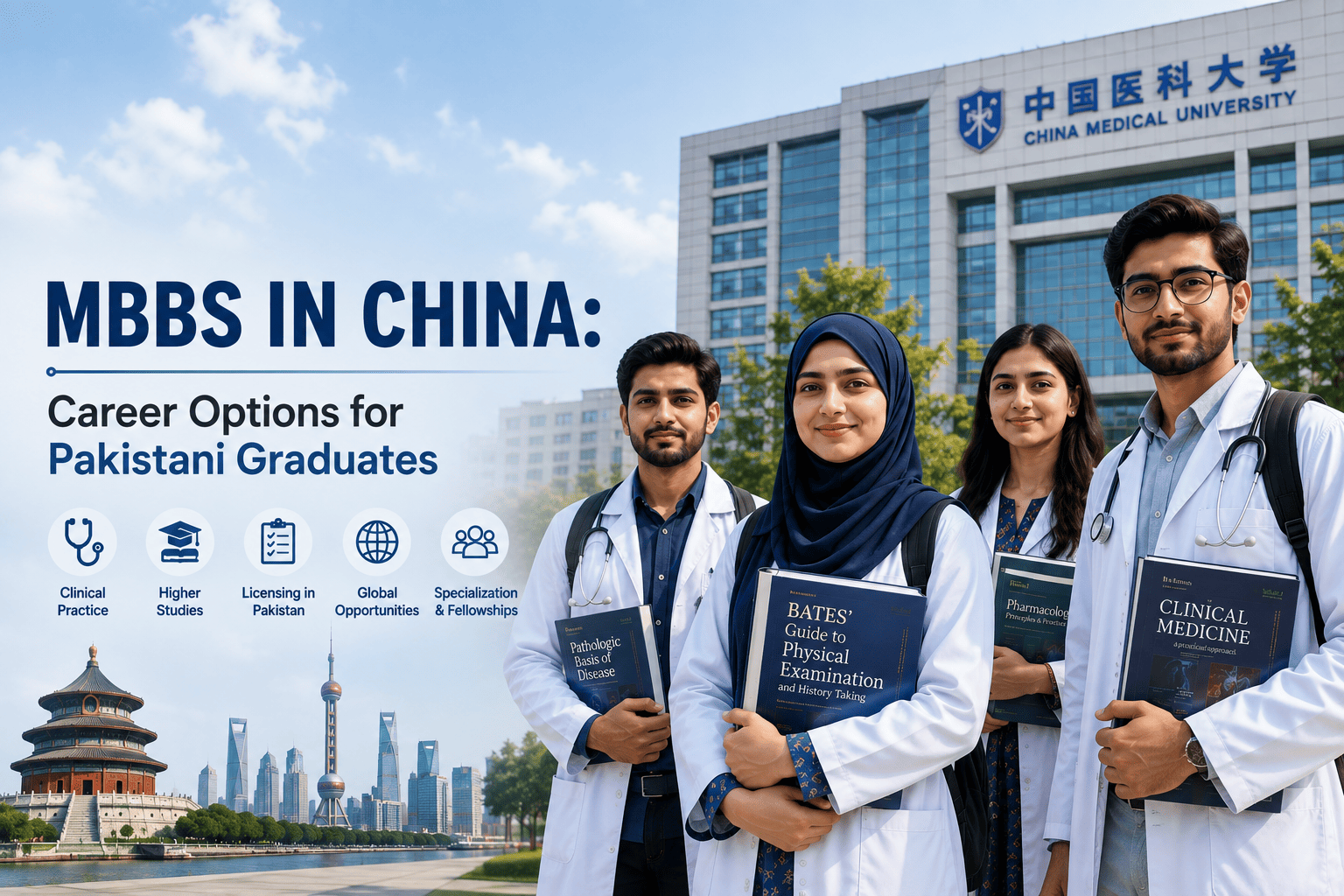
Every year, thousands of Pakistani students leave home for China for the purpose of receiving knowledge from the world’s most prestigious medicine academies. China has become a preferred choice of many Pakistani students because of its low fees, quality education, modern infrastructure, ease of visa process, and other benefits that are hard to ignore. But after obtaining a degree from there and completing a six-year MBBS program, they start wondering about various aspects of their lives. What happens after MBBS in China? What are the possible jobs in Pakistan after obtaining an MBBS degree from China? Is it possible to practice in Pakistan? What are the employment opportunities if they decide to settle down in China?
This blog is written for those students and their parents who actually wish to see the real picture not painted in the brochures by consultancy agencies. Let’s dive in step-by-step.
Coming Back to Pakistan: The First Big Step
The moment your final year in China ends and you receive your MBBS degree, the real journey actually begins. Just having a degree from a Chinese medical university is not sufficient to get a license to practice medicine in Pakistan. There is a due process, a legal and academic procedure that all foreign medical graduates must go through, regardless of where they studied their medicine, be it China, Russia, Kyrgyzstan or another foreign nation.
The first thing you need to check, ideally before you even join a university in China, is whether that institution is recognized by the Pakistan Medical and Dental Council, now more commonly referred to through the Pakistan Medical Commission framework. Not every Chinese medical university makes the cut. The council has a list of recognized universities, and it can change every year, so it would be best to check the latest list from PMDC sources rather than trusting agents or old blogs.
Another new criterion that has been imposed recently is that in order to get your foreign degree recognized in Pakistan, you need to have at least 60 percent marks in FSc Pre Medical or its equivalent and 50 percent in the MDCAT before leaving for China. This regulation was added to the policies for intakes starting from 2024 to 2025, so if you are planning to leave for a Chinese Medical University and take admission from this session onwards, you cannot bypass these MDCAT and FSc requirements.
The National Licensing Examination: Your Real Test
Once you are back in Pakistan with your degree, the actual gatekeeper standing between you and a medical license is the National Licensing Examination, commonly known as the NLE. This exam is not optional. Every single foreign medical graduate, whether they studied in China, the UK, Australia, or the Caribbean, has to sit this test before they can legally practice medicine in Pakistan.
The NLE usually comes in stages. The first part is a computer based theoretical assessment that tests your medical knowledge across all major subjects you studied during your degree. If you clear that, you move on to a clinical skills component, sometimes called an OSCE style exam, where your practical and clinical competence is tested in front of examiners. Both components generally need to be passed separately, often with a minimum score requirement around 60 percent, before you are allowed to proceed further.
Many students underestimate this exam, thinking that after completing their MBBS studies overseas, the rest will be easy, but the truth is that the NLE has a significant failing rate due to the variance in syllabi, practical exposure, and pattern of exams between China and Pakistan. This makes it mandatory for the student to prepare seriously for the exam for about four to six months, going through question banks and past papers.
Once you clear the NLE, you are eligible to move into the house job phase, followed by permanent registration with the medical council, and finally full legal practice rights within Pakistan.
Career Path One: Government and Private Practice in Pakistan
For the majority of graduates, the most common route after clearing the NLE is to complete a house job at a recognized teaching hospital. This one year period is where you actually apply everything you learned in China to real patients under supervision, and it is often described by seniors as the phase where you truly become a doctor rather than just a degree holder.
After the house job, doors open up in multiple directions. Some graduates choose to sit for the FCPS entrance exams to pursue specialization in fields like general surgery, gynecology, internal medicine, pediatrics, or dermatology. Others prefer to join government hospitals through provincial health department recruitment, which offers job security and a structured career ladder. Private hospitals and clinics are another popular option, especially in cities like Lahore, Karachi, Islamabad, and Faisalabad, where private healthcare has been expanding steadily.
Career Path Two: Postgraduate Specialization Abroad
Not every graduate wants to settle immediately into practice. A good number of Pakistani MBBS graduates from China use their degree as a stepping stone toward further specialization in other countries. Passing the NLE is not a requirement for this route since the goal here is not to practice in Pakistan but to move onward internationally.
The United States Medical Licensing Examination (USMLE) is one of the most popular options for students who want to become medical practitioners in the States. Meanwhile, PLAB, the Professional and Linguistic Assessments Board examination, is the preferred choice of those who want to settle in the UK. The AMC exams are an option for those who would like to work in Australia, while the MCCQE is the gateway to Canada. However, Gulf states also offer good job opportunities with attractive pay packets for doctors who are willing to work there. The DHA and Prometric exams are widely popular licensing exams among Pakistani doctors who want to work in the United Arab Emirates and Saudi Arabia. Doctors from Pakistan prefer Gulf countries over western nations due to significantly lesser time spent on the licensing process and greater income potential.
It is important to note that Chinese universities do not hold equal value with respect to these examinations. This is why it is beneficial to research and finalize the university of interest well before enrolling in the program. The universities which are recognized globally by the World Federation for Medical Education or World Directory of Medical Schools have better recognition.
Career Path Three: Working Back In China/Research
There is also a small percentage of students who are interested in staying back in China. It is always easier said than done, but there are options for students who are willing to settle in China. The government encourages postgraduate research, and scholars from Pakistan who did MBBS from China can look for research assistantships and jobs at the same university they studied at. Some students might find it hard to stay back due to language barriers, but those who were confident and conversant with the language during their MBBS could explore this opportunity.
What Actually Determines Success
Talking to graduates who have gone through this process, a common theme seems to emerge. The students who get through this ordeal are rarely the ones who enrolled in the cheapest university with the lowest entry requirements. They are more often than not the ones who double-checked the recognition status, kept track of MDCAT and academic requirements before leaving Pakistan, took their clinical rotations seriously instead of viewing them as a formality, and started their NLE preparations well in advance instead of leaving it to the last minute.
Selecting a university based on lower tuition fees and relatively easy entry requirements might seem like a good idea at eighteen or nineteen, but it can come to bite you severely five or six years down the line when you have to appear for the NLE or when your degree’s recognition is under question. Doing the due diligence early and keeping track of the latest PMDC announcements can save you a lot of headaches in the long run. Similarly, seniors who have already gone through the licensing process are a goldmine of information and should be consulted at every step of the way.
Final Thoughts
The road ahead of an MBBS graduate from China is not a straight path. It can either lead to government jobs, private practice, specializations in other countries, research, or a combination of the mentioned options. The main takeaway from this ordeal should be that the degree is only the beginning, and one’s career after it depends largely on the effort and dedication put into it. The competition is tough, the requirements are constantly changing, and the NLE is not something that can be aced on a whim. For the students currently studying in China or planning to study there, the words of wisdom would be to keep track of PMDC announcements, not rely on agents and blogs, prepare thoroughly for the NLE in advance, and have a bigger picture perspective in mind. The path is demanding, but for those who plan it well, an MBBS from China can genuinely open up a strong and stable medical career, whether that career unfolds in Pakistan or somewhere else in the world.